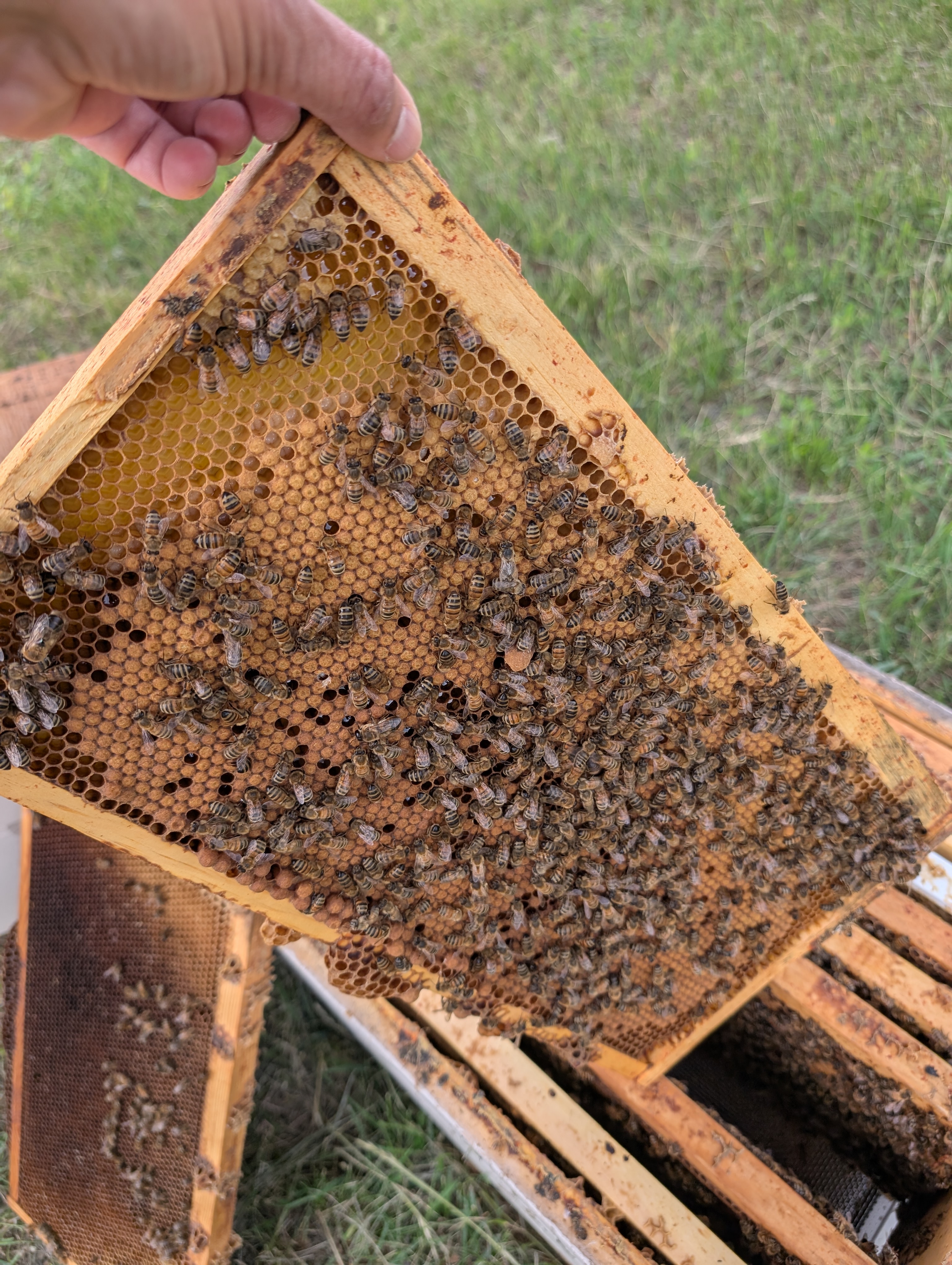
Canadian crops depend on honey bees, but disease and environmental stressors are putting them at risk
The UM Honey Bee Lab is working with local honey bee farmers to keep the bees buzzing.
Honey bees may be best known for making honey, but they also play a vital role in Canadian agriculture, acting as pollinators for important crops like hybrid canola, sunflowers and berries. Their work supports billions of dollars in agricultural production and economic activity each year.
The health of the Western honey bee (Apis Mellifera) is under threat from disease and many environmental stressors, including a rapidly changing climate.
Dr. Nuria Morfin, assistant professor in entomology in the Faculty of Agricultural and Food Sciences, has been awarded a new Natural Sciences and Engineering Research Council (NSERC) Discovery Grant to study how the community of microbes interact with the honey bee to cause disease.
“It’s estimated that honey bee colonies contribute about $7 billion annually to the Canadian economy through pollinating important crops like hybrid canola,” says Morfin. “We need to better understand how stressors interact and affect honey bee health and productivity.”
Since the 1990s, honey bee populations have faced substantial risks due to the introduction of the ectoparasite Varroa destructor (V. destructor). Winter losses in managed hives have increased, from a historically accepted 15% to upwards of 45% in recent years.
“The ectoparasitic mite V. destructor has been identified as one culprit contributing to honey bee losses,” says Morfin. “This parasite attaches itself to and feeds off the bee’s body. Unfortunately, this parasite can compromise the productivity and survival of bee colonies.”
When a parasite attaches to a bee it significantly weakens its immune system. This often leads to viral infections such as deformed wing virus. Until now, researchers have not concentrated on how V. destructor and the collective community of microbes present in honey bees (like bacteria, viruses and fungi) interact and cause disease.
Morfin’s team is working to fill that gap in knowledge.
Morfin and her team at the UM Honey Bee Lab are tackling this research with the pathobiome approach, which recognizes that diseases rarely have a single cause.
For this project, they are assuming that diseases emerge when V. destructor, microorganisms, and other stressors interact with and weaken a bee’s immune system. With a compromised immune system, pathogens can set in and cause disease.
The team will also consider the role of temperature and other environmental stressors on bee health.
“Bees are very sensitive to their environment and changes in temperature or humidity can stress them and take away their ability to fight infections,” says Morfin.
This research will show a full picture of what is causing bees to suffer from diseases and will provide a multifaceted understanding of how V. destructor mites and other stressors, like extreme temperatures, are causing so much damage to colonies.
For Manitoba beekeepers, disease management is a pressing concern and this research could help them sustainably manage their colonies.
"As a beekeeper, I'm grateful for the work done in research labs. They provide us with more tools to help manage mites and diseases so that we can care for them better,” says Laura Wiens, Manitoba Beekeepers' Association.
While there are existing methods to monitor V. destructor mite levels in a colony and miticides exist to chemically treat a hive, they remain ineffective in the long term. The application of synthetic acaricides, for example, must be precisely timed to avoid causing further damage to a colony or contaminating the honey. This is very difficult to manage.
“We have high hopes this new research will provide us with the opportunity to better manage mites and viruses in our colonies,” says Daryl Wright, Manitoba Beekeepers Association member. “Healthy bees are critical to maintaining a sustainable industry well into the future.”
New treatments are needed. The immediate goal of this research is to better understand how V. destructor, microorganisms and environmental stress interact to cause disease. In the longer term, this research could help identify new ways to prevent diseases or treat honey bees.
Healthy honey bee colonies are essential to sustaining strong crop yields and in turn play a vital role in supporting the Manitoba agricultural economy. This important research is taking action to protect and ensure this vital pollinator thrives well into the future.
Clayton H. Riddell Faculty of Environment, Earth and Resources: 2 Discovery Grants
Price Faculty of Engineering: 10 Discovery Grants
Faculty of Agriculture and Food Sciences: 6 Discovery Grants
Rady Faculty of Health Sciences: 8 Discovery Grants
Faculty of Science: 27 Discovery Grants
Faculty of Architecture: 1 Discovery Horizon Grant
For nearly 150 years, UM has transformed lives through groundbreaking research and homegrown innovation. We push the boundaries of knowledge and do the hard work here in Manitoba to move our community and the world forward. With a spirit of determination and discovery, we are shaping a better future for our province and beyond.
Research at the University of Manitoba is partially supported by funding from the Government of Canada Research Support Fund.
Falling Walls Lab Manitoba 2026 celebrates innovation, partnership and community
The 3rd Canadian Research Security Conference convened 200+ participants in Winnipeg.
UM researchers are exploring how our DNA can predict MS decline.
New tech fights bacteria