Can farmers grow more while spraying less?
High-tech tools for sustainable agriculture coming to UM test farm.
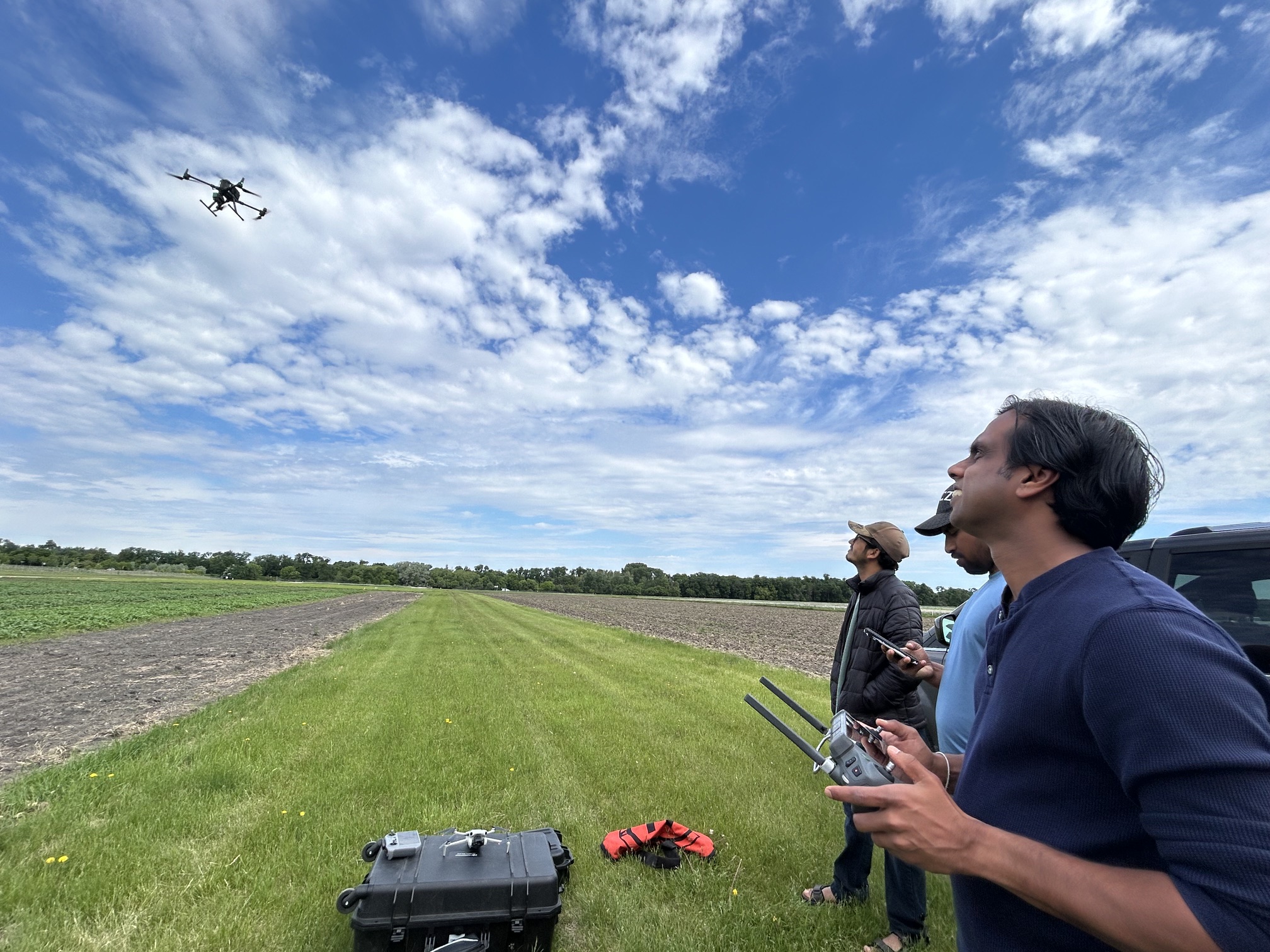
What if farmers could grow the same amount of food while using far fewer chemicals? Using new high-tech tools, Drs. Dilshan Benaragama and Nasem Badreldin are developing technology where yields are maximized while chemicals are used sparingly, only when and where they are truly needed.
This new $676,876 investment through the Canada Foundation for Innovation (CFI) and Research Manitoba John R. Evans Leaders Fund program is building on the ongoing combined research from the Department of Plant Science and the Department Soil Science.
After years of work finding out digital scans using drones and satellites, the team will now upgrade their research. Using new precision spraying equipment, variable rate seeders and a tractor Benaragama and Badreldin plan to plant a test field at Carman, Manitoba.
Today, more and more farmers are using drones and satellites to scout their fields and to develop decision-making tools, but the precision tools needed to put these insights into action are still missing.
“Most universities don’t have access to this kind of precision equipment to test cost savings and environmental benefits of integrating digital technologies on industrial and small plot fields, so this is a unique opportunity for us,” says Benaragama. “I believe in Western Canada, every farmer can benefit from this technology, saving money and reducing the burden on our environment.”
Scouting fields with sensors to soil moisture and nutrition while tracking the spread of pest insects and weeds are accomplishments already achieved by the team with current technology, but a gap remains in identifying the best way to apply their precision data. This project fills that gap and will demonstrate exactly how much a farmer stands to save by upgrading to new digital tools.
“We’re already seeing some self-driving tractors in Western Canada and once our work is done the whole farming process could become autonomous, from seeding, to herbicide spraying to harvest with accurately projected yields,” says Benaragama.
Their first step will be custom building the precision equipment they need since, aside from the tractor, the required smart nozzles and sprayers can’t be bought at the store. Designs will be tailored for different sizes of plots and farms over the winter, ready for testing by the next growing season.
The team hopes to accelerate adoption of precision agriculture, both in Western Canada and in the global context. By engaging farmers as research participants, Benaragama and Badreldin hope to empower producers with custom tools, pre-programmed with scans of their own fields.
“My goal is to leverage these digital tools as a smart farm research and training hub for Western Canada, so that everybody can come and test AI models, prescription maps, decision-making tools,” says Benaragama. “This will be a valuable platform for training the next generation of farmers and will be a demonstration center for farmers to see for themselves how precision agriculture can benefit them.”
Ultimately, researchers are hopeful that the savings from reduced chemical use will pay for upgraded equipment, while growing a cleaner environment for everyone.
For nearly 150 years, UM has transformed lives through groundbreaking research and homegrown innovation. We push the boundaries of knowledge and do the hard work here in Manitoba to move our community and the world forward. With a spirit of determination and discovery, we are shaping a better future for our province and beyond.
Dr. Frederick Zeiler is using elements of neuroscience, engineering and computer science to better understand the brain.
Research team explores how portable brain-monitoring tech could support rehabilitation.
Meet Little Hermie Monterde, the UM PhD grad revolutionizing quantum networks.