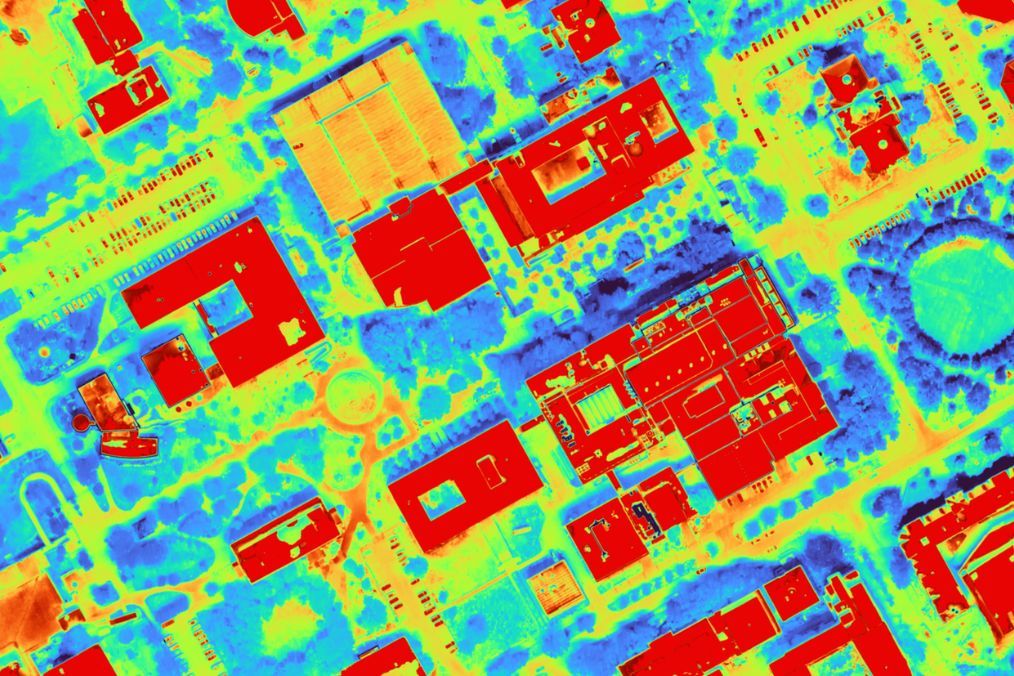
The power of urban forests to keep things cool
Landscape Architecture researcher is using drones to map urban forests.
Western Europe recently experienced the hottest June on record. North American summers are marked by sweltering heat domes and soaring temperatures. With millions seeking ways to keep cool, the shade provided by urban tree canopies is more important than ever.
Dr. Yuhao Lu, assistant professor in the Department of Landscape Architecture, was recently awarded funding through the Natural Sciences and Engineering Research Council (NSERC), Discovery Horizons program to conduct research on mapping urban tree canopies and managing urban heat.
“We’re inspired to do this research because, like over 50% of the world’s population, we live in cities,” says Lu. “We all experience first-hand how trees improve our daily lives, especially in extreme heat.”
Most people would agree that having more trees is beneficial and is especially important as summers become hotter. But how many trees are optimal? Is there a scenario where there can be too many trees, or the wrong kinds of trees? Can trees also be stressed by extreme heat in cities?
This video shows time series drone images of UM campus (video credit, Bayan F. Shaeri).
To answer these questions, Lu’s team will adapt drone technology that has more commonly been used in the agriculture or forestry sectors. They will fly the drones in pre-determined patterns through sections of urban areas, particularly in the City of Winnipeg, to study tree canopies in fine detail. Data from the drones will be used to simulate precise 3-D models of the tree canopies and their surroundings.
The 3-D models will allow the team to count the exact numbers of trees and how they are providing shade over time – comparing data from May and August, for example. They will be able to see where shade exists and identify pockets of intense heat or gaps in the canopy.
"With these models, we plan to co-create training manuals and toolkits with practitioners,” says Lu. “These technically sound and practical tools will mean practitioners have access to richer information to create more equitable, climate-resilient and data-informed design decisions.”
The project was co-designed by a global team of researchers and professionals including:
“Our interdisciplinary team allows us to bridge the divide between the academic research and the professionals and elected officials who make decisions about trees,” says Lu.
Lu and his team are looking to interrupt how people think about their designed environments. If he can help a planner or landscape architect stop and reconsider their assumptions about landscape design or help a policy maker see how the designed environment affects people in profound ways, he will have achieved his goal.
Lu will further refine his research to help decision makers plan urban environments to accommodate for future needs dictated by climate change or technology.
“This research will explore how the data and evidence can be made more useful to practitioners,” says Ryan Litovitch, regional planner and project manager with the Winnipeg Metropolitan Region.
According to Litovitch, municipalities consistently face limited capacity and funding to deploy effective climate adaptation interventions, such as tree canopy improvements.
“New evidence-based tools will provide confidence to practitioners and decision-makers to design and deploy effective projects within budgetary constraints,” says Litovitch. “This research data could also help support ongoing requests for the additional funds we need to scale up climate resiliency programs.”
Lu and his research lab team, Future Elements Studio, plan to scale their work up by partnering with NASA, the Canadian Forest Service and others to track changes to urban green spaces around the world.
For nearly 150 years, UM has transformed lives through groundbreaking research and homegrown innovation. We push the boundaries of knowledge and do the hard work here in Manitoba to move our community and the world forward. With a spirit of determination and discovery, we are shaping a better future for our province and beyond.
Research at the University of Manitoba is partially supported by funding from the Government of Canada Research Support Fund.
UM PhD graduate and postdoctoral fellow Nitesh Sanghai finds purpose and family in ALS research.
Respiratory therapy researcher Dr. Mayson Sousa aims to reduce the risk of ventilator-induced lung injury.
Falling Walls Lab Manitoba 2026 celebrates innovation, partnership and community
The 3rd Canadian Research Security Conference convened 200+ participants in Winnipeg.