The four paths to ethical leadership
Dr. Wang’s new research explores why some leaders learn from mistakes while others repeat them.
Every leader eventually faces difficult decisions in their career. Sometimes mistakes happen, some recover - others make things worse. New research from UM is explaining why.
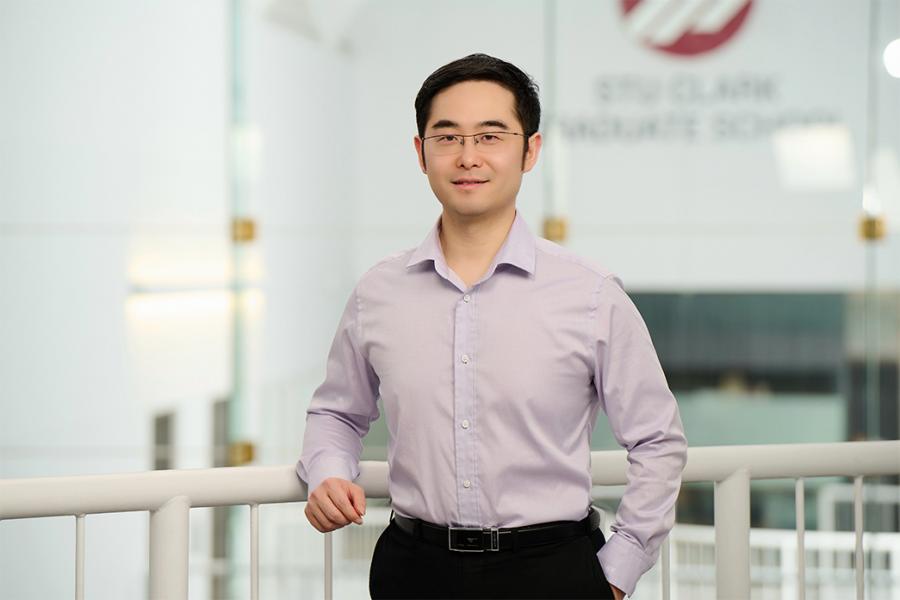
In his new SSHRC funded project Ebbs and Flows of Leader (Un)Ethicality, Dr. Wei Wang is creating practical tools to help the next generation of leaders hold on to ethical commitments through the challenges of their careers. Wang is a professor of Business Administration at the Asper School of Business and was named Associates Fellow in Leadership and Ethics in 2024.
“My goal is to support inclusive workplaces with self-directed tools that any manager can use to help them reflect on the complex decisions they face each day,” says Wang. “I’m inspired by Oscar Wilde when he said, ‘every saint has a past and every sinner has a future’, and I believe that compassion-based self-interventions are the future.”
For organizations and educators hoping to foster more ethical and effective leadership, pinpointing the different paths taken to a lapse in ethics will help reform.
Wang has identified four distinct pathways:
Moral Cleansing – When someone believes that good behaviour now will make up for mistakes in the past.
After decades ignoring health impacts, one tobacco producer testified against the rest to avoid repercussions for themselves.
Moral Licensing – The opposite of moral cleansing, when people believe their past good deeds justify bad actions later.
After decades of charitable work, one nonprofit leader rationalized taking money for personal use as a reward for his contributions.
Moral Escalation – When a commitment to good ethics get’s our of hand, and is used to justify conflict and hostility between co-workers.
One CEO ended her relationship with a key contractor over disagreements between staff, causing financial instability for her company.
Moral Landsliding – Often called the slippery slope – when small mistakes add up to major breaches over time.
One famous financier described for the court how embezzling billions began with minor thefts of hundreds and thousands.
Insights into these problematic paths will help leaders overcome challenges with practical professional development opportunities and develop more ethical working climates for their organizations.
A leader’s actions set the stage for their organization, and micro-interventions like self-reflection and goal setting can promote good habits and accountability. Employees take their cues from a leader’s actions, so subtle changes can have a butterfly effect across an organization.
“We need to normalize a little bit that people make mistakes, and that one mistake doesn't need to define an entire career,” says Wang. “If we can help leaders regulate their decisions by asking identity-based questions like "What should I do?" to "Who do I want to be?" we can prevent small mistakes from becoming career-long trajectories.”
Wang’s study incorporates established theories with observations of real leaders through a critical lens to test their social responses to real world management situations. Once complete, Wang will distill his findings into a publicly available that organizations and managers can use to strengthen ethical decision-making and building healthier workplace cultures.
Follow his progress and access the tool kit once ready the GLOW Lab webpage and the Open Science Framework Platform.
Greg Bak (History), Archives as Research Infrastructure: Understanding the Impact and Effects of Research-Based Decision Making by Archivists, $95,328.
Iain Davidson-Hunt (Natural Resources Institute), Reimaging relations with land, water, and each other: Co-producing a theory and practice of Sustainability Transitions from Below, $484,897.
Laura Funk (Sociology and Criminology), In the business of caring: Exploring how branding activities in seniors housing sustain social divisions, $103,471.
Tristan Miller (Computer Science), Usenet as a Historical and Diachronic Corpus, $394,530.
Sean Byrne (Peace & Conflict Studies), Unseen Transcripts and Untold Stories from a Peace Frontline: The Marginalized Disability Community in Post Peace Accord Northern Ireland and the Border Region, $117,934.
Michelle Faubert (English, Theatre, Film & Media), The Mary Shelley Project, $102,544.
Suzanne McLeod (School of Art), The European "Indian": Genesis of a Constructed Image, $118,750.
Andrew Woolford (Sociology and Criminology), Problem Children: Home Child Removal, Resocialization, and Canadian Childhoods, $92,310.
Rong (Ratchel) Zeng (Asper Behavioural Management Fellow), When Irresponsibility Hurts or Doesn't: The Impact of Corporate Social Irresponsibility on Cross-Border Acquisitions, $118,566.
Danielle Dubois (Religion and Culture), Modern Beguines: Reinventing Medieval Spirituality, $96,655.
Kimia Ansari (Accounting and Finance), Understanding the Dynamics of Human–AI Disagreement: Mechanisms and Conditions Shaping AI Advice Utilization, $65,570.
Yihong Bai (Community and Global Health), Understanding Labour Market Inequities among Transgender and Gender-Diverse Workers in Canada, $97,047.
Peng Liu (Educational Administration, Foundations & Psychology), Exploring the development of optimism among visible minority principals in Manitoba schools, $67,902.
Yuhao Lu (Landscape Architecture), Decoding the DNA of Urban Form: A National-Scale Morphometric Analysis of Canada’s Post-2000 Urban Growth, $90,520.
Mandi Baker (Kinesiology and Recreation Management), Exploring the mental health of youth as they transition from immersive employment experiences: A pilot study of “post-camp blues”, $73,006.
Houda El Mimouni (Computer Science), From Making to Belonging: Culturally Responsive E-Textiles and Robotics Workshops with Marginalized Youth, $93,800.
Amir Michalovich (Curriculum, Teaching and Learning), Embracing refugee-background youth’s difficult knowledge through digital storytelling in mainstream classrooms: Toward a trauma-informed pedagogical model for teachers, $97,227.
Naveed Noor (Global Public Health), Queer Muslim Placemaking: Developing Inclusive and Participatory Research Methods With Queer Muslims In Manitoba, $64,732.
Rasha Baruni (Psychology), Improving Children’s Social Media Safety Through Behavioural Skill-Based Interventions, $76,703.
Anna Chudyk (Pharmacy), Beyond Tokenism: Co-Designing a Communication Toolkit for Participatory Social Science Research, $86,982.
Xiaoxiao Du (Curriculum, Teaching and Learning), Examining Full-Day Kindergarten in Manitoba from an Equity Perspective: Implementation and Impact on Students and Families, $78,152.
Jianning Huang (Accounting and Finance), The Financial Market Implications of News Media, $90,872.
Jonathan Donald Jenner (Economics), Comparative Wage Labour Coercion in Colonial Africa, $48,760.
Erin Keating (English, Theatre, Film & Media), Shaping the Conversation: How Literary Tropes Structure Fan Discourse, $68,971.
Sandra Kouritzin (Curriculum, Teaching, and Learning), Erasure and Epistemic Injustice: Autistic Professors and Institutional Governance in Canadian Universities, $84,671.
Soodeh Saberian (Economics), Effect of Wildfires on Agriculture: Evidence from Canada, $57,315.
Jason Shields (Interior Design), Digital Documentation of Culturally Significant Interiors in Manitoba, $70,812.
Merli Tamtik (Educational Administration, Foundations & Psychology), School Governance Untangled: Multi-level Governance in Public Schools, $92,300.
Rong (Ratchel) Zeng (Asper Behavioural Management Fellow), Purpose Under Tension: How B Corp Models Travel Across Institutions, $64,828.
For nearly 150 years, UM has transformed lives through groundbreaking research and homegrown innovation. We push the boundaries of knowledge and do the hard work here in Manitoba to move our community and the world forward. With a spirit of determination and discovery, we are shaping a better future for our province and beyond.
UM PhD graduate and postdoctoral fellow Nitesh Sanghai finds purpose and family in ALS research.
Respiratory therapy researcher Dr. Mayson Sousa aims to reduce the risk of ventilator-induced lung injury.
Falling Walls Lab Manitoba 2026 celebrates innovation, partnership and community
The 3rd Canadian Research Security Conference convened 200+ participants in Winnipeg.