Cementing the science
How a summer undergraduate research award turned classroom theory into real-world discovery.
For Alexandra Patterson, the abstract concepts learned in classroom snapped into focus this summer.
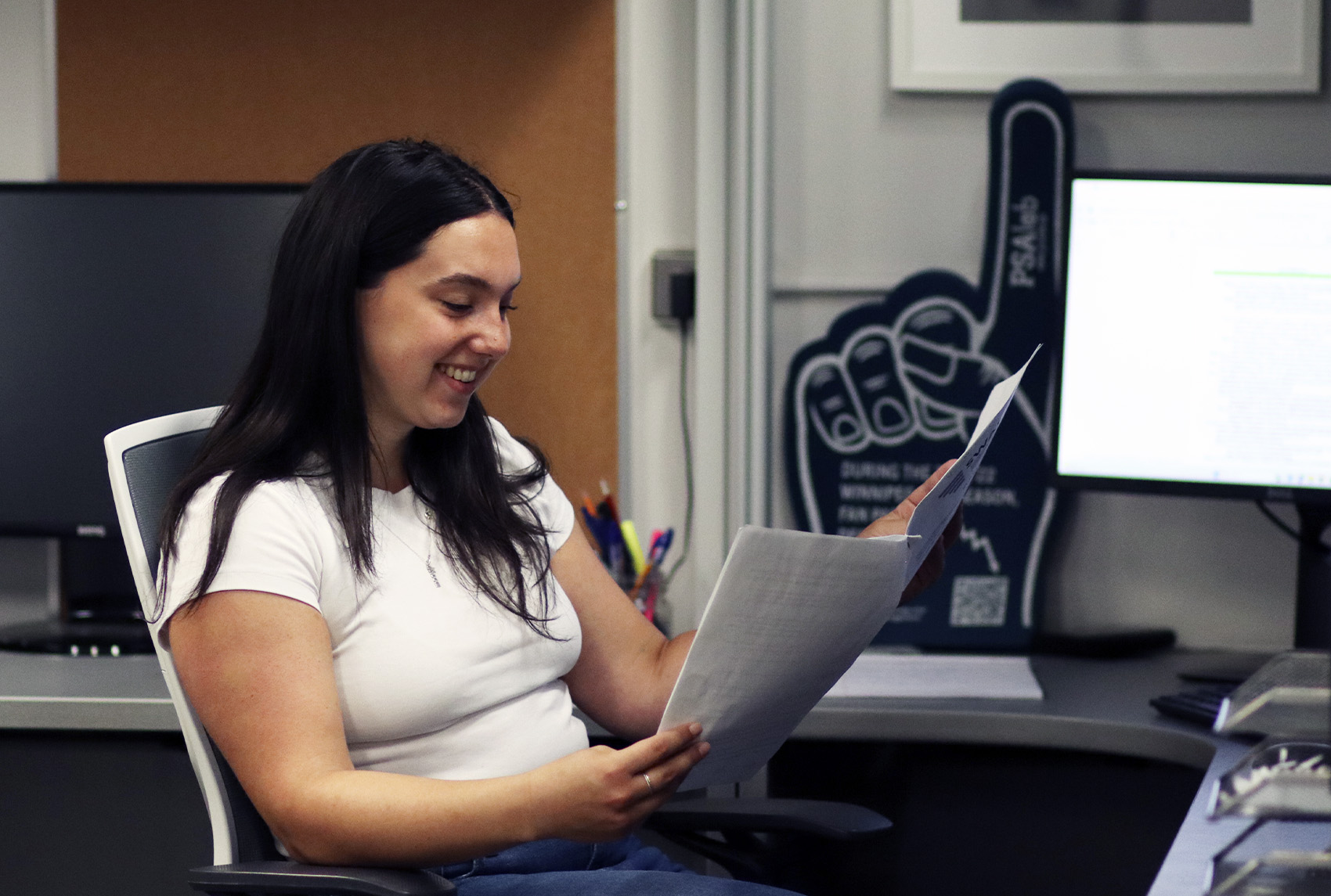
Patterson, a Faculty of Science psychology student minoring in biology who crossed over into the Faculty of Kinesiology and Recreation Management (FKRM) this summer as an undergraduate research award recipient, found her interests intersected in FKRM’s Psychology of Sport and Leisure Activity Lab led by Dr. Ben Schellenberg.
Growing up playing sports, Patterson had always been interested in the crossover between biology and psychology.
"This award has been really cool within the Faculty of Kinesiology and Recreation Management, because kinesiology has always really been interesting to me," says Patterson
"When I started university, I actually started in health sciences and then I ended up making a switch over to psychology," she says.
"So sports psychology is a really interesting intersection of the two--seeing how the biology and the social sciences really interplay with each other."
The project Patterson is working on tracks university athletes throughout their competitive seasons, examining how positive and negative emotions, savouring events, dampening negative events and burnout interrelate to predict different outcomes.
For a student used to traditional coursework, the transition to active research was eye-opening. Patterson says the most rewarding part of the URA experience has been seeing how classroom lessons come to life.
A lot of the stuff that I've been learning in class over the past few years is actually coming into play now," says Patterson. "Once you actually apply it to real research, it's kind of cemented in there. And it's been super fun to be part of a research project from the beginning, seeing how it all comes together and seeing real, raw results."
Working with Dr. Schellenberg has been one of the best parts of Alex’s experience. She appreciates that her supervisor has created an environment where she can really develop her skills.
"[He] gives me a lot of space to learn, to make mistakes and to contribute to the research, and I really feel like I'm making an impact within the lab," says Patterson.
Outside of her daily work, Alex says one of the best parts of the URA program is feeling the collaborative energy in the faculty. Being around students working on all kinds of different projects helped her see just how wide-ranging student research can be.
"It's really interesting to see how many different studies there are going on this summer with all the different students that I've been exposed to, and I've just been able to learn and see how my two interests overlap in a really awesome, supportive environment."
At UM, we encourage life-long curiosity while providing tools – inside and outside the classroom – to succeed in a rapidly changing world. Empowering learners is one of the strategic themes you’ll find in MomentUM: Leading change together, the University of Manitoba’s 2024–2029 strategic plan.
Passion, collaboration, hard work... and rovers. The keys to success for one of the newest student competition teams in the faculty.
Dr. Depeng Jiang turns complex data into evidence that shapes health policy, programs and outcomes.
How one master’s thesis is championing gender-affirming nursing education.
UM PhD graduate and postdoctoral fellow Nitesh Sanghai finds purpose and family in ALS research.