Asthma research earns UM scientist a nomination to attend Lindau Nobel Laureate Meeting
Estimated Read Time:
2 minutes
Courtney Marshall in a lab at the John Buhler Research Centre.
Courtney Marshall in a lab at the John Buhler Research Centre.
Estimated Read Time:
2 minutes
“I'm sure you know multiple people who have asthma — and many who wish for something better.”
That’s how Courtney Marshall, a graduate student at the University of Manitoba’s Rady Faculty of Health Sciences, introduced her research to a group of judges at the International Congress of Academic Medicine (ICAM) in Halifax last April.
At ICAM, the top-performing Canadian PhD student poster presenters are nominated to travel to Germany to attend a Lindau Nobel Laureate Meeting — a gathering of Nobel laureates and selected young scientists from around the world.
“It was a very surreal moment,” Marshall said. “I was so overwhelmed with emotions to be recognized with such a prestigious group of people and awards.”
Dr. Neeloffer Mookherjee, a professor of internal medicine and immunology in Max Rady College of Medicine, is Marshall’s supervisor.
“For a young scientist, this nomination will allow her to interact with the best of the best emerging researchers, not only within our country but internationally,” said Mookherjee. “It also gives Courtney the opportunity to meet Nobel laureates and other global leaders in research. These are the kinds of experiences that shape a scientist’s career and stay with them for life.”
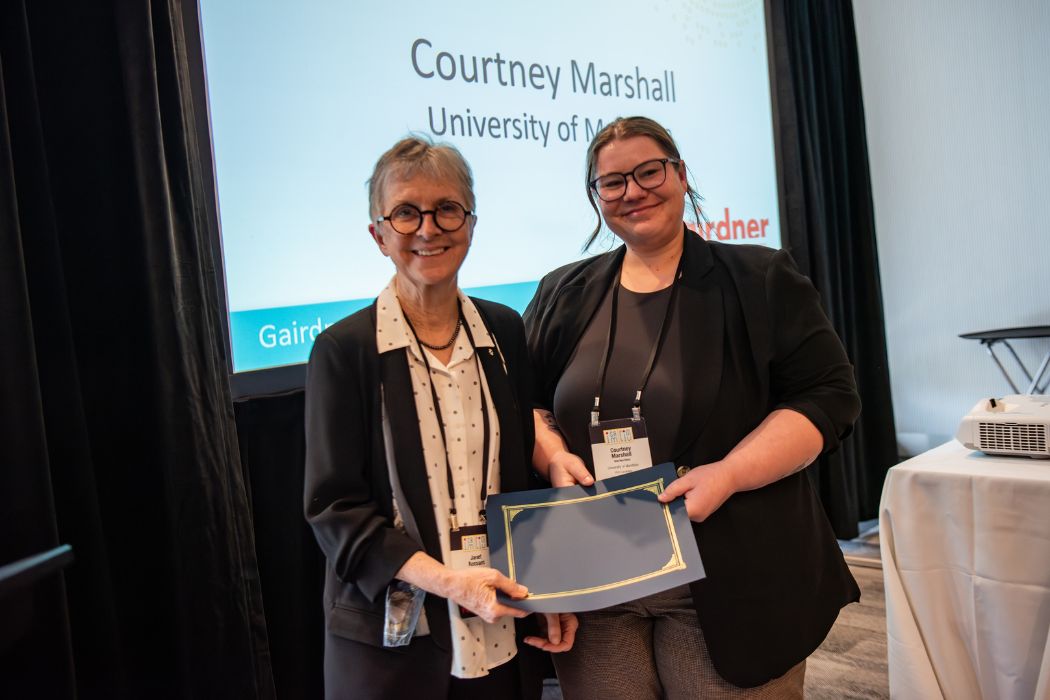
Janet Rossant, president of the Gairdner Foundation, presents an award to Courtney Marshall. Photo by @stoometzphoto, courtesy of ICAM.
More than 100 early-career scientists presented their work at ICAM, using research posters — visual summaries combining text and graphics to clearly communicate research findings.
“You have to tell the story of your research in a very accessible format, so that most people can understand it no matter their background,” said Marshall.
Mookherjee said strong presentation skills are essential to win these awards.
“One can be a brilliant scientist, but communicating your research in a way that makes it impactful for scientists and the general public is a whole other skill set,” Mookherjee said.
For a young scientist, this nomination will allow her to interact with the best of the best emerging researchers, not only within our country but internationally. It also gives Courtney the opportunity to meet Nobel laureates and other global leaders in research.
Dr. Neeloffer Mookherjee
The science behind the award
Marshall’s research aims to understand how a synthetic peptide — designed to mimic the body’s natural infection-fighting proteins — can reduce airway inflammation, a key feature of asthma, and whether it works differently in male and female mice.
“This is important because females tend to suffer more from asthma and respond less to standard treatments, yet most past research has focused on males,” said Marshall.
Her work explores novel therapeutics for chronic diseases like severe asthma, which currently lack effective treatments.
Advice for student researchers
When asked for advice for other students who are preparing to present their research at major conferences, Marshall gave two pointers:
“Show your passion and enthusiasm. When you care about something and you're passionate about it and it comes across that way, it makes other people care about it too.”
“Practice, read and don't be afraid of the question period. A lot of people think the question period is a test, when really, we're all just asking because we're interested in the answer — not to make sure you know the right answer.”
Other UM students from Max Rady College of Medicine also stood out at the event
Allison Balasko: Gold Award, department of medical microbiology and infectious diseases
Berardino Petrelli: Gold Award, department of biochemistry and medical genetics
Diane Malu Tshikudi: Honourable Mention, department of immunology