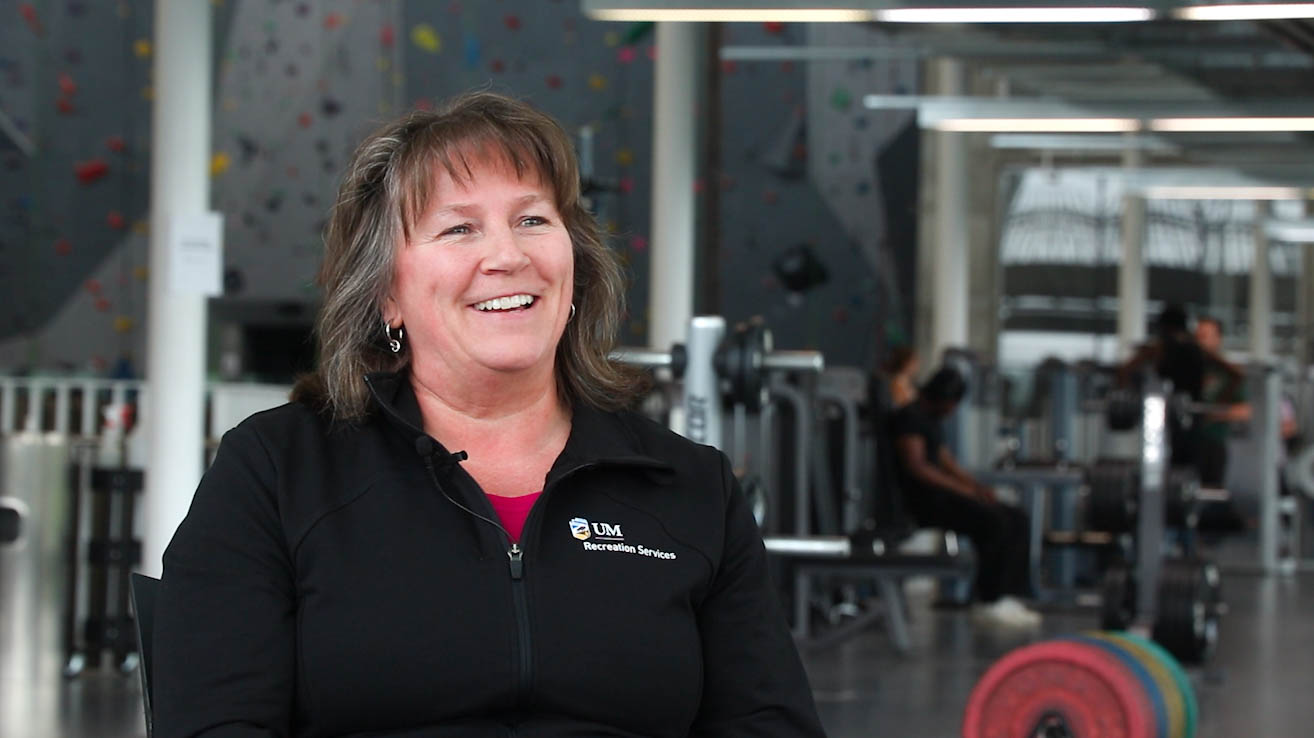
Active Living Centre celebrates ten years of building healthy communities
Ten years ago, on February 25, 2015, the Active Living Centre (ALC) opened its doors for the first time. A new icon on UM’s Fort Garry campus, the building was designed to be “extroverted, communicative and engaging.” Now, a decade later, the building’s legacy extends far beyond its award-winning architecture.
“It’s a gathering place and whether you’re a student, an employee, an academic or anyone, they’re all coming here for a common purpose,” says Julia Panchyshyn, a Manager of the Human Resources Service Centre at UM.
For over 20 years, Panchyshyn has also been a group fitness instructor for Recreation Services. She says she’s seen firsthand how the facility enabled a “very special” community to grow on campus.
“It’s a really tight-knit community, and I think working on campus, you run across people that have been in your classes or at the gym, and you make these connections,” she says.
The facility, designed by Cibinel Architecture in collaboration with Batteríid Architects, replaced the “gritty” grotto, the former basement-level workout facility. In addition to the updated fitness facilities, the building also houses the High Performance Training Centre, the heart of strength and conditioning for Bisons student-athletes and the Applied Research Centre, a hub for faculty research advancing our understanding of kinesiology.
When it opened, Faculty of Kinesiology and Recreation Management Dean Douglas Brown said the new facility, with its floor-to-ceiling windows, was a “renaissance fitness cathedral.”
“I love that in almost every corner of this space, you’re looking out at the sunshine and the green,” said Kaylee Green, a program coordinator with Mini U. “We’re really lucky here with how accessible it is, how safe it is and the opportunity to play and be a part of this community.”
Green says the space creates the chance for Mini U to expose campers to new experiences they weren’t previously able to accommodate, like more climbing programs on the 32-foot wall. She says many of the climbing leaders today were once kids in the climbing camps years ago.
“It’s been nice that [ kids who’ve gone through Mini U programs] want to stay here and they want to share that passion with the kids,” she says. “It’s great to see that sometimes their passion starts here, at an almost grassroots level.”
When the building opened, Brown says the goal was to create a space that would help draw people into the campus and community. Green says it’s done more than just that; it has become a safe and comfortable place for many young campers.
Green says many of the campers look up to the people in the community, like instructors they meet and older athletes they see working out. Getting to engage in the same facilities as them gives them a “goal” for their future.
Prema Bursa says she shares a similar enthusiasm for the community in the ALC.
“I love working out with all the students because it gives me the energy to push myself,” the longtime member says. “I see what they’re doing and I want to do the same.”
Bursa, a senior in the community who has been a member for over 30 years, says it’s the people that keep her coming six days a week (Fridays are her rest day).
“It’s the people, the members, the staff, the fitness attendants, the reception desk, everybody. They’re all so helpful, so wonderful and such passionate people,” she says.
Panchyshyn says the welcoming feeling the community has in the space is really its defining feature. She says the anxiousness of going to the gym lightens when you see the familiar faces of the attendants and members.
“It just makes it that much easier and takes that scariness away,” she says. “Then you’ll recognize someone another time, or see them elsewhere on campus, and you now have this connection which just makes things a little easier each time.”
Programming engaging recreation and outreach in the Active Living Center, whether it be through Recreation Services, Mini U or Bisons Sports is part of the faculty’s strategic plan centered around building health communities.
The Bisons Integrated Support Team brings a holistic approach to supporting student-athletes
Mini U's culture is intentionally shaped by empowering their team through leadership training and professional development.
We asked heart expert Dr. Lorrie Kirshenbaum, Director of the Institute of Cardiovascular Sciences at St. Boniface Hospital.