Symposium looks at advancing nursing’s future through research
College of Nursing’s annual Helen Glass Research Symposium featured a keynote speaker, panel and research presentations.
Estimated Read Time:
4 minutes
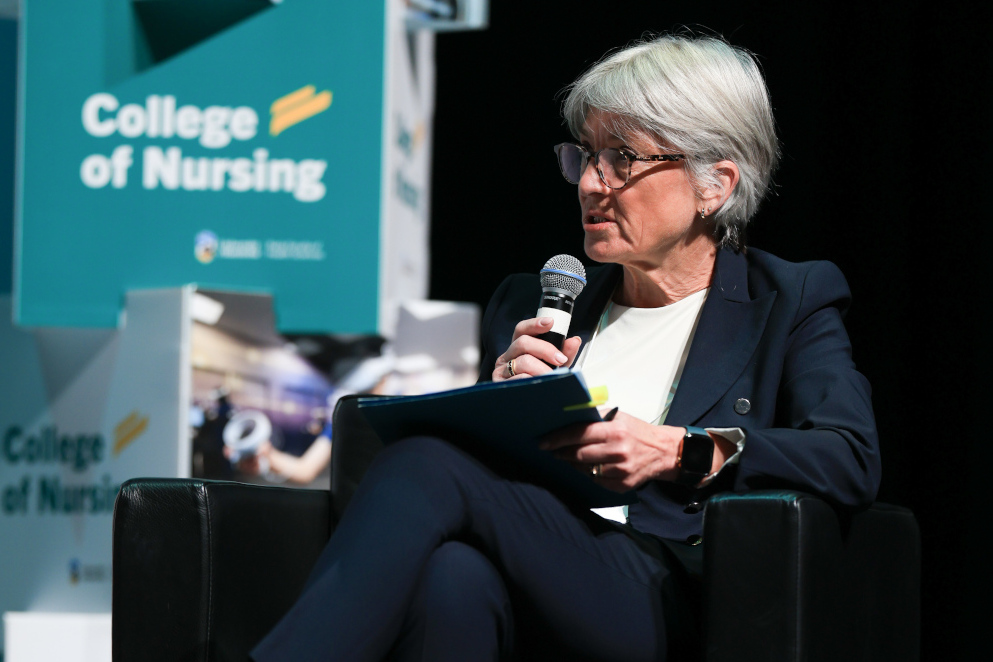
Dr. Greta Cummings gave the keynote lecture at the Helen Glass Research Symposium.
Dr. Greta Cummings gave the keynote lecture at the Helen Glass Research Symposium.
Estimated Read Time:
4 minutes
By
Matthew Kruchak
A leader in Canadian nursing education said the future of nurse-led research is bright, bold and transformative.
“It is important to recognize for yourselves that nurse researchers hold a unique power. They understand patients at the deepest level and have the scientific tools to change how care is delivered globally,” said Dr. Greta Cummings, professor and emeritus dean at the University of Alberta’s Faculty of Nursing and founding dean of the College of Health Sciences.
Cummings gave the keynote lecture at the annual Helen Glass Research Symposium on May 12 at the Desautels Concert Hall on the Fort Garry campus. About 150 people attended the symposium, held in honour of Dr. Helen Glass, the former director of the UM School of Nursing (now the College of Nursing) and a dedicated pioneer of the nursing profession.
The symposium’s theme was From Insight to Impact: Advancing Nursing’s Future Through Research.
The event included five sessions on topics ranging from research in practice and policy to education and mentorship-focused research. The event also included poster presentations and a panel discussion.
Facing challenges and seizing opportunities
Cummings’ talk covered several challenges in nursing research and the many opportunities available in the future.
One challenge Cummings discussed was funding and resource scarcity. She said that Canadian nursing schools compete for Canadian Institutes of Health Research projects against medicine and basic sciences, with nursing scholars receiving smaller and fewer awards relative to their biomedical counterparts.
Another difficulty Cummings talked about was the problem nursing schools face when hiring faculty members. She said 40 per cent of nursing schools cite salary as the top barrier to recruitment because academic pay can’t match clinical sector wages, especially in senior positions.
As well as giving the keynote lecture, Dr. Greta Cummings also moderated the panel discussion.
Cummings spoke about an opportunity to address the faculty shortage in Canadian nursing schools. She said that some Canadian universities are piloting three-year intensive PhD programs with financial support to increase the number of people ready to step into faculty positions.
She said that opportunities exist in the areas of health equity and community-centered research.
“Priority areas identified for nursing research are Indigenous health and reconciliation, racialized communities and anti-racism, rural and remote care, which is extremely important for Canada’s North, 2SLGBTQIA+, and mental health and addictions,” Cummings said.
‘Go for it’
The Manitoba Centre for Nursing and Health Research’s 40th anniversary panel was moderated by Cummings. The panel included Dr. Wanda Phillips-Beck, associate professor, College of Nursing, and Indigenous research chair, First Nations Health and Social Secretariat of Manitoba; Dr. Maureen Heaman, professor emerita, College of Nursing; and Dr. Claire Betker, scientific director, National Collaborating Centre for Determinants of Health.
The panelists answered several questions and discussed topics related to nursing research.
Phillips-Beck said the value of nursing research for Indigenous people is only now being explored.
“It’s so very necessary because we need to understand the realities of Indigenous people’s lives and health-care systems,” Phillips-Beck said.
Photo 1: Dr. Wanda Phillips-Beck. Photo 2: Dr. Maureen Heaman. Photo 3: Dr. Claire Betker.
Reflecting back on her career, Heaman shared a few words of wisdom.
“For researchers, first of all, develop a program of research, stay focused, become known for your expertise in a certain area, and don’t get too sidetracked. Develop a team that works well together and whose knowledge about research methods complements each other,” Heaman said.
Betker said the future of nursing research is advocating for what researchers need and pursuing it.
“I think we have so much to offer, and unfortunately, we have kind of punched below our weight, but I see huge hope here today and sophistication. So yeah, go for it,” Betker said.
Students showcase studies
About 20 faculty members and students had the opportunity to present research posters in the lobby of the concert hall.
Vera Amponsah, a College of Nursing master’s student, presented her study that investigated how the structural elements of organizational and psychological empowerment influenced nurses’ experiences during the COVID-19 pandemic.
She said research is important in the nursing profession because it informs practice.
“With evidence, we can make better decisions,” Amponsah said. “Without research, without any findings, we just remain as we are.”
Photo 1: Vera Amponsah. Photo 2: Eunice Assem-Erhaze. Photo 3: Mai Anh Dang.
Eunice Assem-Erhaze, a College of Nursing PhD candidate, said that she likes everything about research.
“I like the writing aspect,” she said. “I like the thinking process where you have to put down how you come up with ideas,” she said.
The research Assem-Erhaze presented explores how new graduate nurses with learning disabilities experience the early transition from student to the workforce in Manitoba. The study also examines how disclosure and workplace accommodations relate to professional belonging and psychological safety.
Mai Anh Dang, a College of Nursing research assistant and undergraduate student in the Faculty of Science, presented a review of programs that help internationally educated nurses transition into practice.
“I’m very excited to be here,” Anh Dang said. “This is a valuable experience for me to practice my presentation skills and to meet and talk with so many scholars and experts in the field.”
Learn more about innovative research taking place at the College of Nursing:
For nearly 150 years, UM has transformed lives through groundbreaking research and homegrown innovation. We push the boundaries of knowledge and do the hard work here in Manitoba to move our community and the world forward. With a spirit of determination and discovery, we are shaping a better future for our province and beyond.