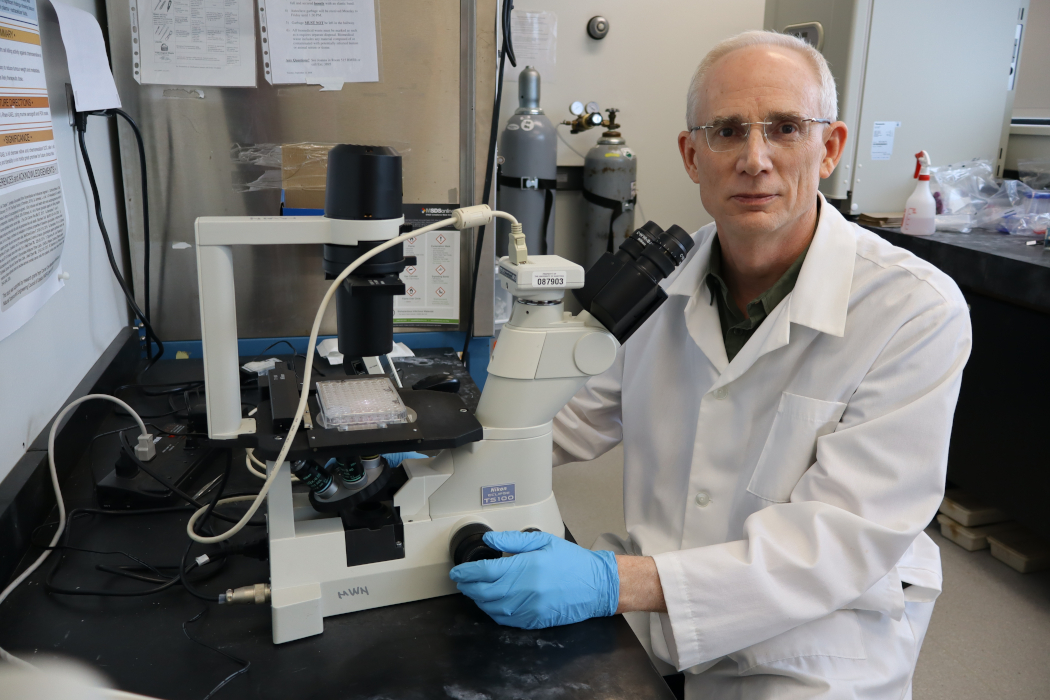
Dr. Mark Nachtigal, professor of biochemistry and medical genetics at the Max Rady College of Medicine, leads three of the six UM projects that received funding from Ovarian Cancer Canada thanks to the Province of Manitoba.
Six UM projects received a total of $1 million in funding from Ovarian Cancer Canada thanks to the Province of Manitoba.
Estimated Read Time:
3 minutes
Dr. Mark Nachtigal, professor of biochemistry and medical genetics at the Max Rady College of Medicine, leads three of the six UM projects that received funding from Ovarian Cancer Canada thanks to the Province of Manitoba.
By
Matthew Kruchak
Researchers at the University of Manitoba are working hard to better understand ovarian cancer and develop innovative new treatments.
Their efforts just got a boost from Ovarian Cancer Canada thanks to a $1 million commitment from the Province of Manitoba. Six UM research projects will receive funding, which are in collaboration with patient partner groups.
Three of the projects are led by Dr. Mark Nachtigal, professor of biochemistry and medical genetics, in collaboration with numerous colleagues and gynecological oncology faculty members at the Max Rady College of Medicine, Rady Faculty of Health Sciences. He said he and his colleagues who are studying ovarian cancer at UM are grateful for the funding.
“About 3,000 Canadians will be diagnosed with ovarian cancer this year. The investment from Ovarian Cancer Canada and the Province of Manitoba will allow UM scientists to help improve the outcomes for ovarian cancer patients,” Nachtigal said. “That’s what is driving this research.”
Dr. Mark Nachtigal
The first of Nachtigal’s interconnected projects will expand the Manitoba Ovarian Cancer Biobank (MOBP), which stores samples of blood, DNA and tumour tissue from ovarian cancer patients. The grant will primarily fund the salary of a tumour bank technician, who obtains donated samples from patients.
For Nachtigal’s second grant, he and his team will create new mouse models using donated patient tumours from the MOBP. He said it will allow them to study ovarian cancer in a more realistic way than in a petri dish.
“The first two grants are about having resources available to anybody wanting to do ovarian cancer research in Manitoba. It allows us to continue to increase the number of scientists in the province looking at this disease,” Nachtigal said.
For the third study, Nachtigal will test the efficacy of L-Rham, which belongs to a class of drugs called glycosylated antitumor ether lipid (GAEL), on the new mouse models. He hopes L-Rham will prevent ovarian cancer and ascites, the abnormal accumulation of fluid in the abdomen, from developing in these mouse models.
Grant recipients
Developing a more effective treatment
Dr. Sabine Kuss, department head and associate professor of chemistry at the Faculty of Science, and her team are developing a new method that uses electrical sensors to measure how cancer cells behave in real time. By detecting small molecules released by the cells, she said they can quickly determine whether the cells are responding to treatment or resisting it.
“Chemotherapy resistance remains a major clinical challenge, with 70 to 80 per cent of ovarian cancer patients relapsing with drug-resistance,” Kuss said. “Current methods to assess resistance are slow and indirect, limiting their clinical utility. Our new approach could help doctors choose the most effective therapy earlier, avoid ineffective treatments and improve outcomes for patients.”
Dr. Sabine Kuss
Understanding BC200
Dr. Sean McKenna, acting dean of the Faculty of Science and a professor of chemistry, received funding to understand how a small nucleic acid molecule, an RNA known as BC200, helps to regulate the production of proteins central to ovarian cancer.
“We will correlate our findings with patient outcomes, such as chemotherapy response and survival,” he said. “Ultimately the work will help to understand a key regulatory steps in cancer progression, help develop a biomarker and potentially form the basis for therapeutic intervention.”
Dr. Sean McKenna
Detecting ovarian cancer early
Dr. Ju-Yoon Yoon, assistant professor of pathology and laboratory medicine at the Max Rady College of Medicine, received funding to study whether they can detect ovarian cancer before the early stages. Yoon and his team are hoping to learn about the molecular timeline of ovarian cancer formation.
“Ultimately, we hope to lay the foundation for genetics-based screening program,” Yoon said. “While mutations are known to occur very early in formation of ovarian cancer, those mutations are not specific for ovarian cancer. By studying the larger picture, we hope to identify other changes that may be helpful for early detection.”
Dr. Ju-Yoon Yoon
Boilerplate: Research
For nearly 150 years, UM has transformed lives through groundbreaking research and homegrown innovation. We push the boundaries of knowledge and do the hard work here in Manitoba to move our community and the world forward. With a spirit of determination and discovery, we are shaping a better future for our province and beyond. Learn how UM is advancing change through research.