Rady researcher returns to her roots to share expertise in Brazil
Innovative course in Rio de Janeiro offers opportunity for mentorship and knowledge exchange.
Estimated Read Time:
3 minutes
The group that took part in the course led by Dr. Elaine Anjos outside a historic building on the Fiocruz campus in Rio de Janeiro.
The group that took part in the course led by Dr. Elaine Anjos outside a historic building on the Fiocruz campus in Rio de Janeiro.
Estimated Read Time:
3 minutes
By
Matthew Kruchak
Dr. Elaine Anjos is grateful to have earned her PhD from the University of Manitoba in 2020 thanks to a Science Without Borders Program scholarship from the Brazilian government.
Born and raised in Brazil, Anjos wanted to give back to her homeland because the scholarship provided her the chance to advance her academic training, experience a new culture and allow for personal growth.
So Anjos, lead research associate with Genetically Engineered Model Services (GEMS), Rady Faculty of Health Sciences, decided to instruct a course earlier this year in Brazil focused on CRISPR-Cas technology.
The course covered the revolutionary technology that lets researchers change the DNA of mice with extremely high precision for biomedical research to test new medications or to understand genetic diseases.
“I’m so happy to have had the opportunity to share the knowledge that I learned here in Canada,” Anjos said. “I feel happy and proud of being part of this process.”
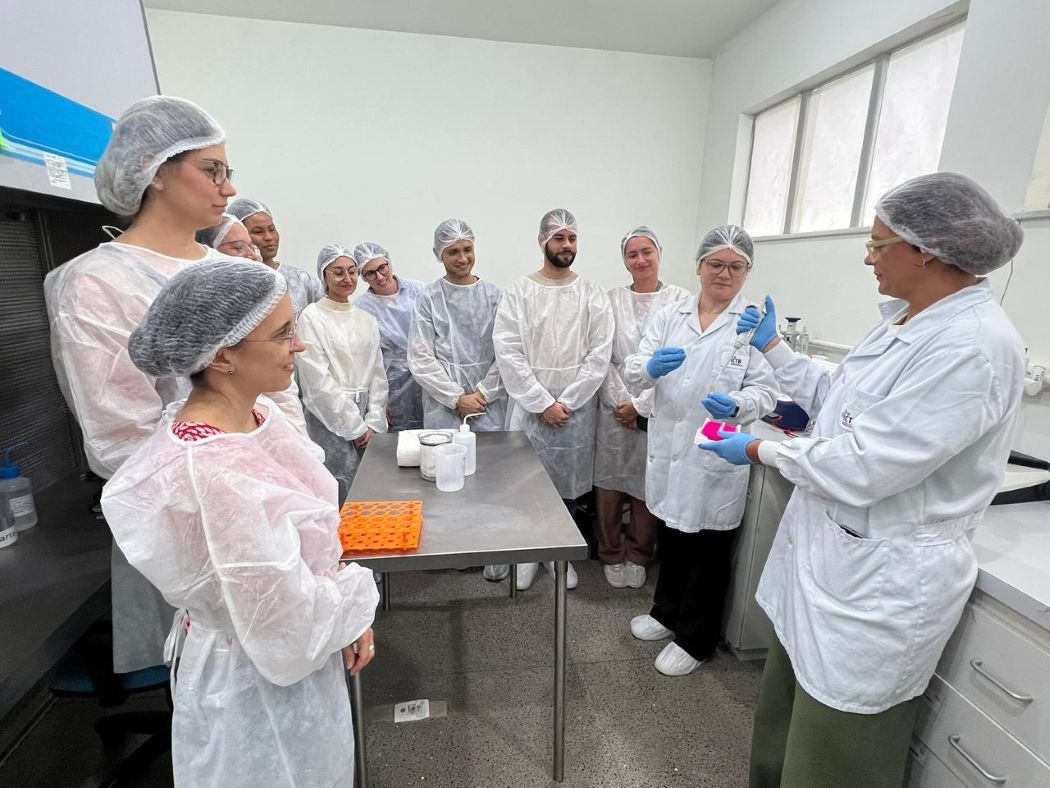
Dr. Elaine Anjos (second from the right) led a week-long course on CRISPR-Cas technology at Fiocruz in Rio de Janeiro.
In demand expertise
The weeklong course, which included lectures and in-lab experiments, took place on Fiocruz’s Rio de Janeiro campus. Fiocruz is a Brazilian public research institute.
Ninety people from across Brazil applied for 12 spots. Because of the high demand, Anjos plans to hold the course again in the future.
“The training offered in the course is essential for professionals to integrate cutting-edge technologies and innovation into their practices, positioning them at the forefront of the advances in medical research and new experimental therapies,” Anjos said.
“I hope the students can apply this knowledge to advance their research and contribute to the development of science.”
They clearly appreciated her outreach, and I think it is a great example of how training at UM can have an impact that extends well beyond our own campus.
Dr. Brad Doble, scientific director of GEMS, and associate professor of pediatrics and child health, and biochemistry and medical genetics, Max Rady College of Medicine
The course was open to graduate students and those already working in the field.
Paula Borba Cruz, a senior public health technician at Fiocruz, took the course. She is currently working on a research project that uses CRISPR-Cas technology, so she enrolled to increase her knowledge.
“I’m not aware of any similar courses in Brazil that include a practical component,” Borba Cruz said. “It was so important to me to understand the entire CRISPR methodology through theoretical and practical classes.”
The course content was based on the knowledge and experience Anjos gained from UM and GEMS, a Rady Faculty service she works for that creates animal models using CRISPR-Cas9 techniques for researchers to use in their studies.
Canada and Brazil collaboration
Dr. Brad Doble, scientific director of GEMS, said he was happy that Anjos took the initiative to develop and instruct the course.
“It is wonderful to see Elaine take what she has learned at the University of Manitoba and bring it back home to share with an eager audience of Brazilian scientists,” said Doble, an associate professor of pediatrics and child health, and biochemistry and medical genetics, at the Max Rady College of Medicine.
“They clearly appreciated her outreach, and I think it is a great example of how training at UM can have an impact that extends well beyond our own campus.”
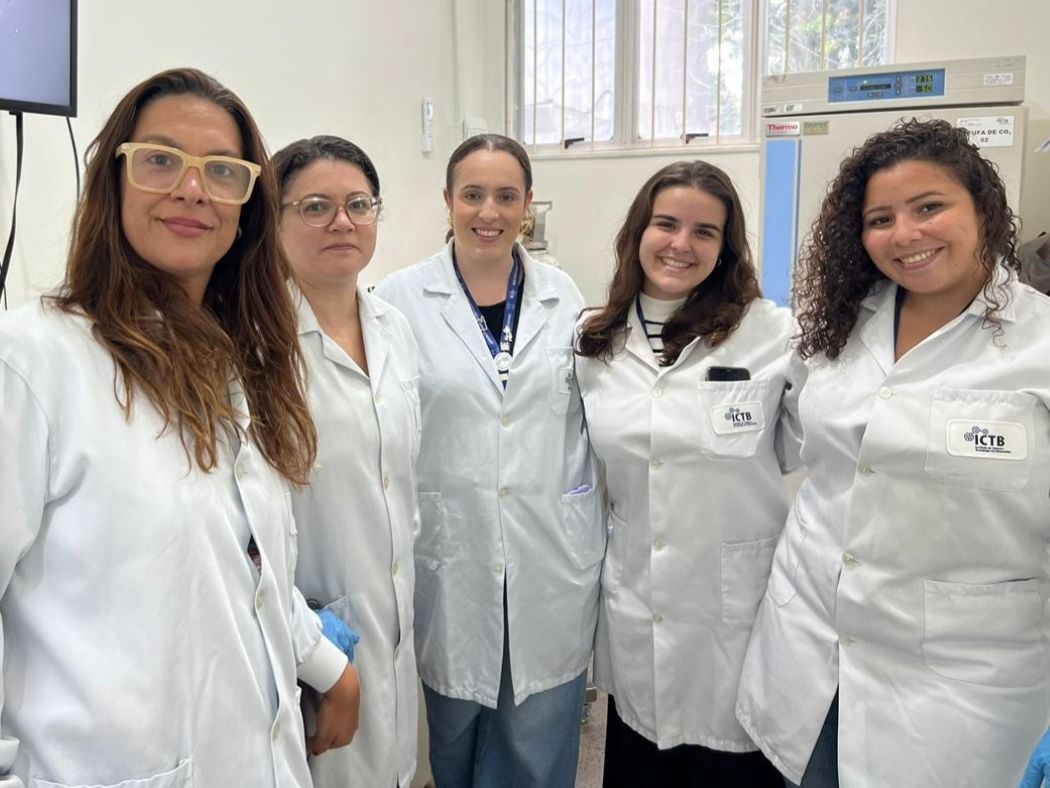
The group that helped run the course. [From left to right] Dr. Luciene Paschoal Braga Dias, Dr. Elaine Anjos, Isadora Paiva, Maria Eduarda Valente and Larissa Barbosa.
Anjos’ outreach efforts have led to a Brazilian student joining UM as a visiting student researcher for two months. The student will gain practical experience in genome editing.
“In the world we live in right now, collaboration between countries is essential for everyone,” Anjos said.
“I’m happy to be part of this and continue to collaborate. It strengthens the partnership between Canada and Brazil by promoting the exchange of knowledge and expanding technological capacity in Latin America.”
The course was presented by Fiocruz’s Institute of Science and Technology in Biomodels, in partnership with the National School of Public Health Sergio Arouca and the Institute of Technology in Pharmaceuticals in Brazil.
Learn more about UM's Genetically Engineered Model Services:
UM is home to researchers and scholars who respond to emerging issues and lead innovation in our province and around the world. Creating knowledge that matters is one of the strategic themes you’ll find in MomentUM: Leading change together the University of Manitoba’s 2024–2029 strategic plan.