Medical student explores connection between depletion of a brain protein and multiple sclerosis

Ha Ryun Yang inspired by the bachelor of science in medicine program at the Max Rady College of Medicine.

Ha Ryun Yang in a lab.
Estimated Read Time:
3 minutes
Estimated Read Time:
3 minutes
By

Matthew Kruchak

Before enrolling in the bachelor of science in medicine (B.Sc. (Med.)) program, Ha Ryun Yang said he understood that research can be a lengthy process.

After completing the B.Sc. (Med.) program, the third-year med students said he can now appreciate the time and effort that goes into a research project because of the hands-on experience he received.

The B.Sc. (Med.) program allows medical students to spend two summers – following their first and second years of the four-year MD program – immersed in research. Medical students also have the opportunity to enroll in a single summer research program.

Under the guidance of Dr. Soheila Karimi, professor of physiology and pathophysiology at the Max Rady College of Medicine, Yang worked on a project focused on a protein called neuregulin-1 (Nrg-1). Karimi’s team had previously discovered that the protein is depleted in the brains of people and mice with multiple sclerosis.

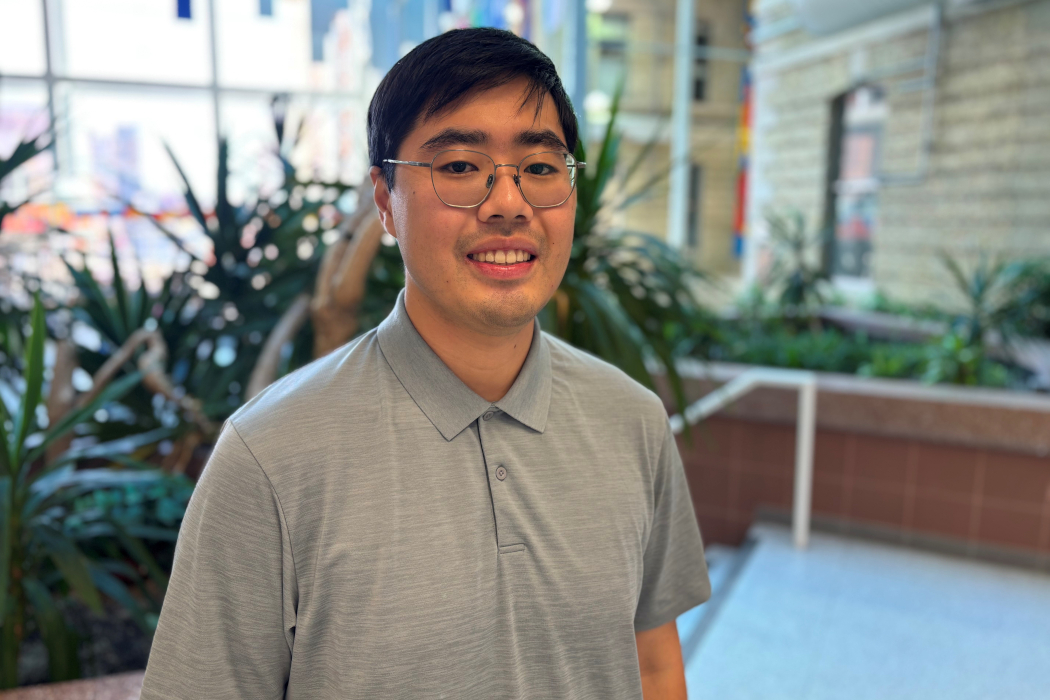
Ha Ryun Yang in Brodie Centre atrium on the Bannatyne campus.

Yang’s research was part of a greater project to track mice without Nrg-1 over 44 weeks to observe whether the lack of the protein causes symptoms commonly seen in multiple sclerosis and if these symptoms are intermittent, chronic or progressive.

“Some of the symptoms I helped track were problems with memory, such as whether they recognize an object or not. And problems with anxiety,” said Yang.

“I hope this research, and the greater project that is currently going on right now, helps characterize the role of the Nrg-1 protein in the central nervous system and establish it as a contributing factor to the development of progressive multiple sclerosis.”

UM Today sat down with Yang to learn about his experience as a B.Sc. (Med.) student at UM.  

Why did you enroll in the B.Sc. (Med.) program?  

I’ve always been interested in research, and I did an honours degree where I did a thesis in fourth year. And the area that I want to go into in medicine is pathology, which is a research heavy area with new innovations coming out all the time.  

I wanted to familiarize myself with the process of research, and to gain an appreciation of what goes on behind the scenes that make the discoveries possible for things like medications and other treatment regimens.

How will the B.Sc. (Med.) experience help you as a future physician?

I think the insight I gained into the scientific process will really help me in the future. Since I want to go into pathology, gaining an appreciation for why this is diagnostic of some disease, like how was that ever found out? Is it due to experiment or an association that they found or a population study? So, I think it will help me appreciate that more.  

Has the B.Sc. (Med.) program increased your interest in conducting research after medical school?  

Yes, I think now I’m even more motivated to possibly pursue some sort of research degree like an MD/PhD. I’ve heard good things about the program and the things that come with it, like it’s busier or it might take longer to finish residency.  

I feel like it would definitely help me throughout residency to learn the topics, gain an appreciation and contribute to important medical discoveries.

What would you say to someone who is thinking about enrolling in the B.Sc. (Med.) program?  

I think it’s to consider how much they like research. Research is a topic that’s brought up frequently in medical school for CVs and Canadian Resident Matching Service interviews. People might think it’s an opportunity to pad their resume, but the B.Sc. (Med.) program requires good commitment and a good understanding of the topic that you’re researching.

Learn more about the B.Sc. (Med.) program and the one Summer Research Program. 

Boilerplate: Empowering Learners

At UM, we encourage life-long curiosity while providing tools – inside and outside the classroom – to succeed in a rapidly changing world. Empowering learners is one of the strategic themes you’ll find in MomentUM: Leading change together, the University of Manitoba’s 2024–2029 strategic plan.