Manitoba Legal Clinic for the Arts reaches Northwards

Law students make impact on artists at Northern Perspectives Conference and imagiNorthern Summit

A group of people in parkas stand inside Flin Flon's famous snow lodge
Estimated Read Time:
10 minutes
Summit attendees, including Manitoba Legal Clinic for the Arts students and supervisory staff, imagiNorthern organizers and others inside Flin Flon’s incredible Snow Lodge.
Estimated Read Time:
10 minutes
By

Manitoba Legal Clinic for the Arts

This winter, law students working at the Manitoba Legal Clinic for the Arts turned their attention northwards as part of the clinic’s ongoing outreach activities to ensure artists based in the north have access to legal knowledge and information to help them grow creatively and economically.

On February 7, 2026, Clinic students both gave a presentation and ran an booth on behalf of the Clinic at the Northern Perspectives 2026 Conference co-hosted by the Kivalliq Chamber of Commerce and the Baffin Regional Chamber of Commerce at the Victoria Inn in Winnipeg.

From February 20 to 22, 2026, third-year law students Jessie Canard and Cole Hutchison travelled to Flin Flon to attend the imagiNorthern Summit 2026, to learn from Northern Manitobans, and offer support to a movement of transformational possibility that is rapidly gaining momentum.

Upon returning from these outreach endeavours, Clinic students shared insights into northern artists’ business and legal needs, and critical lessons learned.

Why IP matters more than ever for Inuit artists: Copyright, resale rights, and the future of creative work in Nunavut

The Northern Perspectives conference brought together political and industry leaders, artists, entrepreneurs, policymakers to discuss trade, innovation, economic development, entrepreneurship, cultural industries, and to spotlight opportunities for partnerships between Manitoba and Nunavut for creative and economic growth. Third-year students Paul Chorney, Travis Dech, and Vanessa Smith, delivered an engaging and highly interactive presentation focused on intellectual property (IP), Artist Resale Rights (ARR), and new tools available to creators through Canada’s new online resource IP Central. 

The session that Chorney, Dech and Smith led, sparked lively discussions with artists raising questions and sharing their own experiences navigating copyright, resale markets and more.

Why in-person presentations and face-to-face conversations matter

The importance of meeting Inuit artists in person was clear throughout the day. As Chorney reflected, “The in-person presentation underscored how vital meeting in-person is for Inuit and Indigenous communities, where knowledge is traditionally shared through oral teaching. Discussions on copyright and intellectual property for artists also made clear that expanding opportunities to learn and exchange knowledge with creatives in the North is not just valuable, but essential to also protecting their livelihoods.”

First-languages, access, and inclusion

Accessibility and inclusivity were also central to the event. The students’ presentation was interpreted into Inuktitut by Theresie Tungilik, O.C., allowing Inuit artists to participate in both English and Inuktitut ensuring the event was inclusive and accessible to the entire community. This made sharing information and participating in conversations about intellectual property and related subjects open to everyone. Smith said, “Talking with artists and hearing questions asked in multiple languages really demonstrated how important it is that legal information be accessible to creative communities across the North, including in Indigenous languages.”

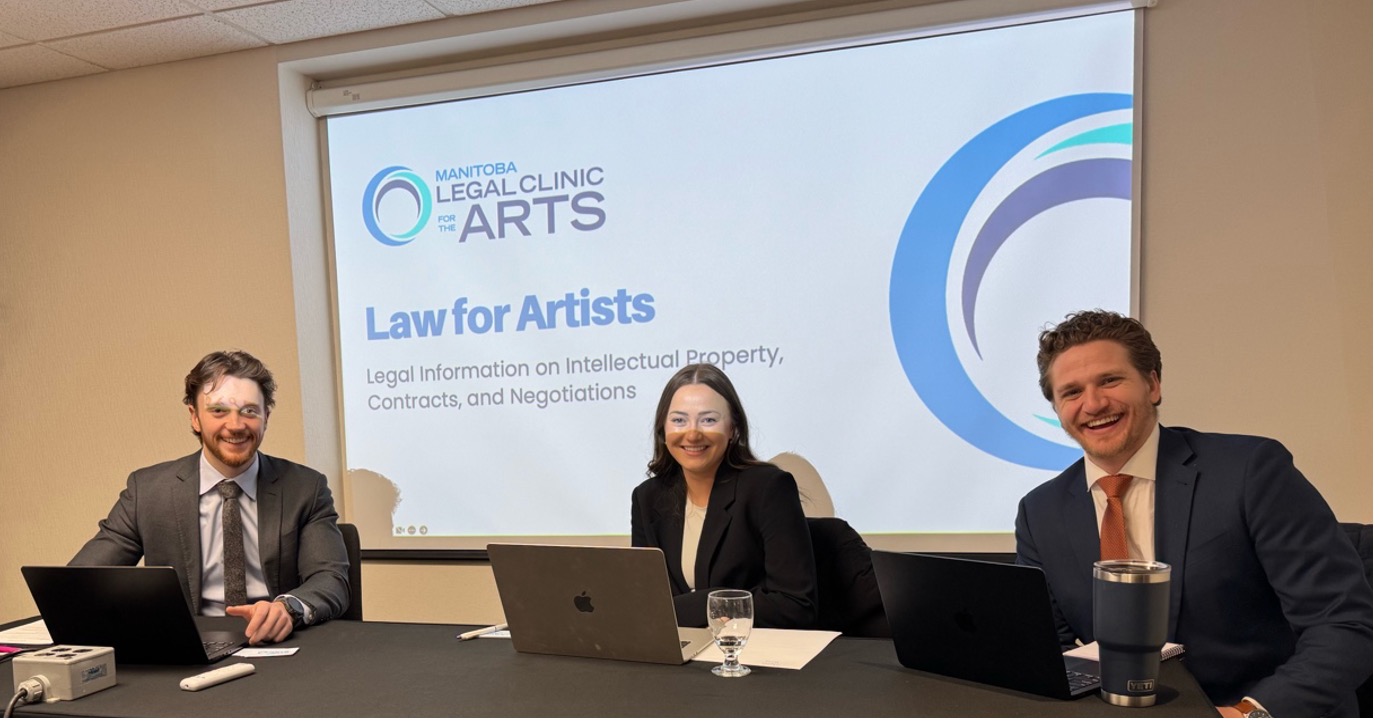
Three law students in business suits sit in front of laptop computers in front of a screen that says Manitoba Legal Clinic for the Arts Law for Artists
From left to right: third-year law students Paul Chorney, Vanessa Smith, Travis Dech

The law students were most appreciative of Tungilik’s translation services and got to meet her as well. She is a well-known, highly respected Inuit artist and national arts leader from Rankin Inlet, Nunavut. In her own artistic practice, she creates wall hangings depicting the lives of Inuit people. Tungilik is also a past President of Canadian Artists’ Representation/Le Front des artistes canadiens, known as CARFAC,  a national organization advocating for Canadian visual artists. In 2023, she was also CARFAC’s first-ever Inuk president. She has also been on the board of the Winnipeg Art Gallery and a member of the Indigenous Advisory Committee for Qaumajuq, the WAG’s Inuit Art Centre.  Passionate about the protection of Inuit art, she has long been inspired to help Inuit artists, and for years has been a champion advocating for Artist’s Resale Right in Canada. 

Artist’s Resale Rights (ARR)

One of the highlights of the presentation was a discussion around Artist’s Resale Rights (ARR), which is expected will soon be a reality in Canada.  ARR would allow visual artists to receive a royalty each time their work is resold on the secondary market, ensuring creators benefit as the value of their work increases over time – just as already done in over 90 other countries. The federal government announced intent to implement ARR in its November 2025 budget as part of the “Canada Strong” plan. Artists, advocates including the Clinic are closely watching for further details concerning implementation of ARR. 

The potential impact of ARR is particularly significant for Inuit visual artists and improving their economic conditions. As Dech explained, “Art is one of the most important ways that communities can cement their culture and heritage for generations, but also their livelihoods. Giving artists information on how to control, protect and benefit from their works is not only a way we as a Clinic can provide practical legal information and assistance, but also an invaluable way to ensure Inuit culture and heritage can be protected and respected for generations to come. I am so grateful I was able to meet and provide these artists with the information we did in our presentation.”

Importance of signing artwork

The presentation also addressed practical issues and challenges. Resale royalties depend on correctly identifying artists, meaning unsigned or illegibly signed works can prevent artists from receiving future ARR payments. Students emphasized that signing work protects artists and may help them benefit from future resale rights when ARR is implemented in Canada. Reflecting on these conversations, Smith noted, “Listening to artists share their work and the care they put into it reinforced how vital it is that they have the tools to protect and benefit from their creations over time.”

New tools and resources: IP Central

Another key topic was  IP Central, a new free online service platform offered by the Canadian Intellectual Property Office designed as a one-stop destination to help Canadians, including artists and creators, start on their intellectual property journey, to better understanding and managing their intellectual property. IP Central offers guidance on protecting and profiting from creative work, connects users with IP advisors, and provides webinars and educational resources accessible across Canada. For Manitoba artists seeking legal guidance, Manitoba Legal Clinic for the Arts students also encouraged participants to reach out to the Clinic’s free services directly too.

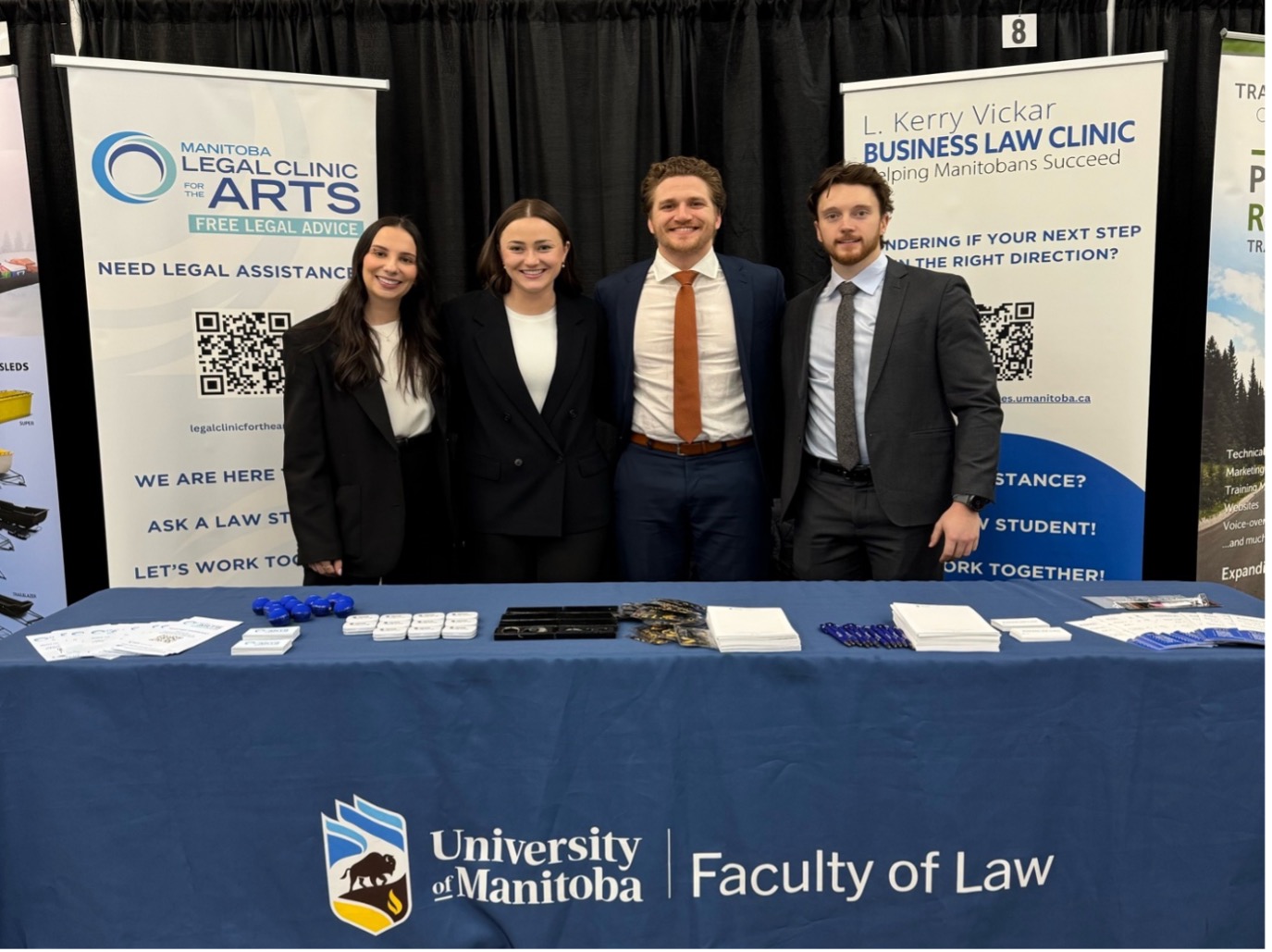
law students in suits and ties stand at an info booth between two roll up banners for the Kerry Vickar Business Law Clinic and the Arts Clinic
From left to right:  law students Serena Bevilacqua, Vanessa Smith, Travis Dech, Paul Chorney

In addition to the presentation, the students also hosted an information booth at the Conference’s tradeshow, where artists could continue conversations and others attending the conference could learn about clinic services and the Faculty of Law. Dech, Chorney, Smith, as well as Serena Bevilacqua, Nav Nain, Gilad Stitz, and Sparsh Kohli were on hand to answer questions about copyright, contracts, and protecting creative work. 

These interactions confirmed how community outreach and events like the Northern Perspectives 2026 Conference help bridge gaps despite geographic distances, bring people to together, including legal clinicians, cultural workers, and artists to collaborate in ways that support and strengthen sustainable creative communities.

For the Manitoba Legal Clinic and for the Arts team, meeting Inuit artists confirmed there is a very real and growing need for accessible legal information in the North, that not all learning occurs in classrooms, it is essential to support Northern creative entrepreneurs, meeting people in-person, as well as learning, understanding and respecting cultural diversity and the importance of first languages to Inuit communities. 

By the North, for the North, in the North

This theme of "By the North, for the North, in the North" took center stage throughout the imagiNorthern Summit and captured both the spirit of the gathering. It also helped create a blueprint for their future as artists, by amplifying the North’s creative voices and strengthening a Northern creative economy.

At its heart was a question that continues to guide the imagiNorthern Network’s work: How can the arts connect people in the North and connect people to the North?

Northern creativity

In Manitoba, the North represents roughly 80% of the province's landmass. The imagiNorthern Network was incubated by the Flin Flon Arts Council in early 2021 and created to strengthen communities and bring together creative voices in Flin Flon, The Pas, Opaskwayak Cree Nation, Snow Lake, Thompson, Churchill, and Lac Brochet. 

The ImagiNorthern Network supports visual artists, makers, photographers, musicians, culinary artists, and creatives of all styles who make up the North’s creative canvas. This work is grounded in the belief that the arts are not only a cultural force but a powerful driver of community development, sustainability, and economic transformation.

This significant work is also rooted in removing barriers of distance, building links between communities, and advancing and supporting thriving, inclusive arts and cultural sectors in communities in the North that play an essential role in a diversified Northern economy. 

The principal aim of the Summit was to explore how the success of the imagiNorthern Network could be expanded to other communities across the North and beyond by cultivating shared experiences and a sense of belonging. The focus is on the arts, food, sustainability, Northern economic development, and reflects a vision that is both practical, innovative as well as essential to strengthening every Northern community.

The imagiNorthern Network is unique, community-based, community-driven, and consensus-based, with enormous potential to improve communities and support livelihoods by enhancing collaboration, sharing experiences, solving problems, bringing people closer despite geographic distances, and working together. This same Northern spirit is also part of something larger occurring in the North, it’s recognizing the North's potential and resources that can benefit all of Manitoba. 

From pandemic roots to a growing Northern network

The imagiNorthern Network originally emerged in response to the isolation and social distancing mandates of the COVID-19 pandemic. What began as a way to stay connected during a time of separation has grown into a coordinated effort to strengthen and elevate Northern Manitoba’s communities and the creative economy in the North, with a mission to:

  • Grow local creative economies

  • Prepare communities and creators for export

  • Distribute unique products worldwide, and

  • move Northern creative work beyond local boundaries

This would connect artists and arts groups to national and global markets while amplifying their cultural impact.

The most important thing a facilitator must do is to include the voices of the people as early as possible. So, the people who it’s about speak first and foremost

Ingra Petri, Strategic Moves

Marking a turning point

The imagiNorthern Summit served as a pivotal “decision point” for the development and expansion of the imagiNorthern Network. The discussions concluded with a plan to transition the network from an initiative incubated by the Flin Flon Arts Council to an independent, community-driven, separately incorporated non-profit organization in the near future.

Many sessions were facilitated by Inga Petri of Strategic Moves from Whitehorse, Yukon. Inga emphasized the importance of community input, saying, “The most important thing a facilitator must do is to include the voices of the people as early as possible. So, the people who it’s about speak first and foremost.”

Fiona Rettie from Churchill, who is Project Manager of the imagiNorthern Network, and Roy Mexted, a musician, member of the Churchill Creative Collective, and Northern Champion Coordinator of the imagiNorthern Network, also led collaborative sessions on community priorities and next steps for the organization.

The passion involved and the possibilities this network can create are nothing but exciting

Jessie Canard, third-year law student

Bringing Communities Together

Summit attendee Cody Wood from Thompson shared, “imagiNorthern’s openness to integrate everyone, including people who don’t have a connection to the group, is warming. They are forward‑thinking, looking at people who can help achieve the goal. It is exciting to work with the results‑oriented team and to be included in the decision‑making as part of a younger generation.”

Third-year law student Jessie Canard mentioned, “Investing in artists is something we need more of, which makes what imagiNorthern something special. The passion involved and the possibilities this network can create are nothing but exciting. I can’t wait to see how the network grows. You also don’t need to be from the North to be involved in the network either.”

Second‑year law student Cole Hutchison reflected on the Summit: “Seeing the dedicated group come together to continue turning the idea of imagiNorthern into an autonomous organization was inspiring, and the conversations throughout the summit were meaningful.”

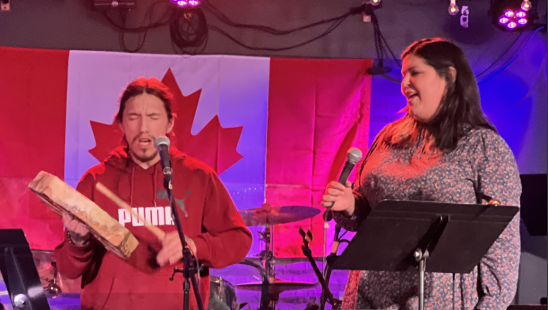
a man sings into a microphone while striking a flat handheld drum with a wood mallet and a woman sings into a microphone next to him
Cody Wood of Thompson and Law Student Jessie Canard (3L) perform Makwa (The Bear Song) together at Johnny’s Social Club.

Experiencing Flin Flon’s Arts Community

The imagiNorthern Summit was held at the City of Flin Flon Council Building. Flin Flon is approximately 764 kilometres from Winnipeg. Flin Flon is a mining city, home to approximately 4,700 residents, and has a very vibrant arts community that summit attendees experienced firsthand. Visits to the NorVA Centre showcased local artwork and creative spaces. Evenings at Johnny’s Social Club filled the room with music and connection. A stop at the Flin Flon Snow Lodge offered a glimpse into the region’s unique cultural landscape.

As Fiona Rettie noted, “My favourite part of every conference is the time spent outside of the meetings, all that time where you are able to connect with each other.”

Clinic Outreach in Northern Manitoba

The students also had the opportunity to share with attendees the work the Manitoba Legal Clinic for the Arts does. The Clinic provides legal assistance for artists, arts groups, and people in the creative sector, including support with governance, intellectual property, contracts, and more. 

This was the Clinic’s third trip within 12 months to different communities in Northern Manitoba. The Clinic and its law students are dedicated to supporting Northern communities and removing barriers to accessing legal services in the North. 

The Clinic believes the North deserves and is entitled to the same opportunities to succeed as those in the South, and looks forward to assisting in turning conversations into action, supporting the imagiNorthern Network, as well as the communities and people in the North.

Acknowledgement

The Clinic is incredibly grateful for the support of Innovation, Science & Economic Development Canada through the IP Clinics Program Grant funding, which makes these essential in-person, face-to-face Northern visits possible.

Boilerplate: Community

Creating space for everyone to thrive is more than a goal—it’s who we are. Fostering a vibrant community is among the commitments you’ll find in MomentUM: Leading change together, the University of Manitoba’s 2024–2029 strategic plan.