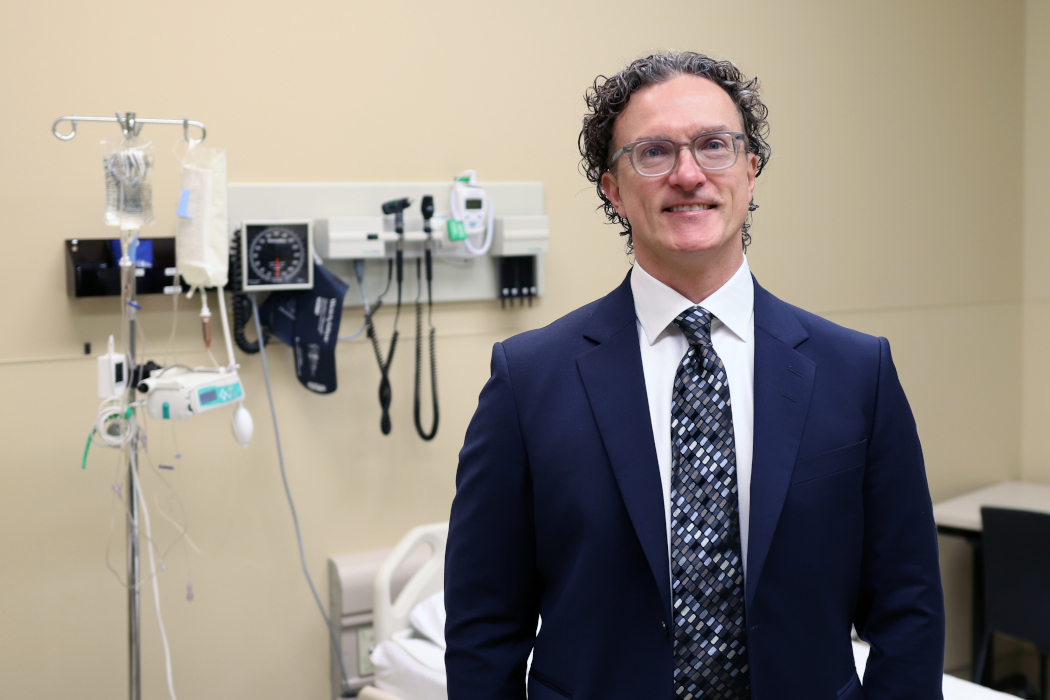
Dr. Ryan Zarychanski is on a mission to modernize clinical trials.
Estimated Read Time:
4 minutes
Estimated Read Time:
4 minutes
By
Matthew Kruchak
Dr. Ryan Zarychanski [B.Sc./95, B.Sc. (Med.)/2000] was speaking about heparin, a blood thinner with anti-inflammatory properties, at a critical care conference in Wuhan, China, just three months before the start of the COVID-19 pandemic. The subway was virtually empty and touring local hospitals was discouraged. A lot of what he was experiencing in China was new to him, but at the same time he got a sense that something wasn’t right.
Shortly after he returned to Winnipeg, the virus had spread to Europe – and then onto North America.
When physicians realized that people with COVID-19 were dying from inflammation and blood clots, colleagues in Europe and China urged Zarychanski to study heparin in people with COVID-19.
Zarychanski’s clinical trial was studying heparin, an inexpensive and widely available blood thinner, and its effects on people who were critically ill.
“I was faced with a hard decision – continue the trial or abandon the research and pivot to study the drug in the context of a global pandemic,” says Zarychanski, professor of internal medicine at the Max Rady College of Medicine.
If he did change course, he would have to assemble a large-scale trial in a short amount of time. Zarychanski wasn’t certain how to proceed, but recalled the words of his mentor, the late Frank Plummer [MD/76], a UM distinguished professor emeritus of medical microbiology and infectious diseases: ‘Ryan, one day, something unexpected will come your way, and my strong advice to you, be open to new opportunities, even if you didn’t expect them.’
Zarychanski decided to pivot. That decision would change not only the trajectory of his research, but ultimately the care of patients around the world By conducting international clinical trials, Zarychanski and his team discovered that when non-critically ill patients were treated with heparin their survival improved and the need for vital organ support was reduced. In a concurrent trial, he found that heparin was not beneficial to patients already critically ill. Both results were simultaneously published in the prestigious New England Journal of Medicine (NEJM) at the height of the pandemic in 2021.
“I’m proud that we were able to identify a therapy that worked and probably saved many thousands from dying or becoming critically ill,” Zarychanski says.
The future of medicine isn’t simply discovering new treatments. It’s creating a health-care system that learns from every patient, every day.
Dr. Ryan Zarychanski, professor of internal medicine, Max Rady College of Medicine
Zarychanski and his team also reported in the NEJM that hydroxychloroquine, used to treat malaria, did not prevent COVID-19. Because of the study, its use to treat COVID-19 patients was stopped.
Not only did they produce life-saving research, Zarychanski and colleagues developed innovative new clinical trial methods to efficiently test treatments such as bringing multiple international research groups together into a multi-platform randomized controlled trial. By sharing protocols and federating data, they answered urgent clinical questions in months instead of years.
“The pandemic showed us that science moves faster when researchers work as one team instead of many,” says Zarychanski, who is scientific director of the George and Fay Yee Centre for Healthcare Innovation.
On a mission to modernize clinical trials
Raised in Charleswood, Zarychanski earned his medical degree from the University of Ottawa. He came home to Winnipeg and completed his residency in internal medicine, followed by fellowships in hematology and critical care medicine, all at UM. He returned to Ottawa for his master of science in epidemiology and clinical trials.
What became apparent to Zarychanski during the pandemic was that embedding clinical trials into clinical care is what’s needed. Zarychanski is driving this idea forward. Earlier this year, he was appointed the UM Canada Research Chair in clinical trials and it’s his mission to modernize how clinical trials are designed, conducted and embedded into everyday care.
“In the course of caring for patients, we generate a tremendous amount of clinical data, including laboratory and imaging results, treatments and outcomes,” he says.
Zarychanski and his team’s most recent paper in the NEJM reported that tranexamic acid, an inexpensive drug that prevents excessive bleeding and stabilizes blood clots, reduced transfusions across major surgeries without increasing the risk of blood clots.
“We wanted to show that a large clinical trial can be integrated into care and be done at a fraction of the cost of typical randomized trials. A study of this kind usually costs up to $13 million and we were able to do it for just $2 million,” Zarychanski says.
'New superpower for UM'
Zarychanski has also made it easier for physicians in Manitoba and across Canada to set up clinical trials within hospitals. A year ago, Zarychanski founded Aurora Clinical Research, a not-for-profit clinical trial unit based at UM.
“Manitoba has been an outstanding participant in clinical trials, but it’s rare for us to lead or sponsor clinical trials. Aurora gives Manitoba investigators the ability to lead large clinical trials and the infrastructure to test new therapies and models of care developed here in Manitoba.
“This is a new superpower for UM and opportunity for investigators at UM,” says Zarychanski.
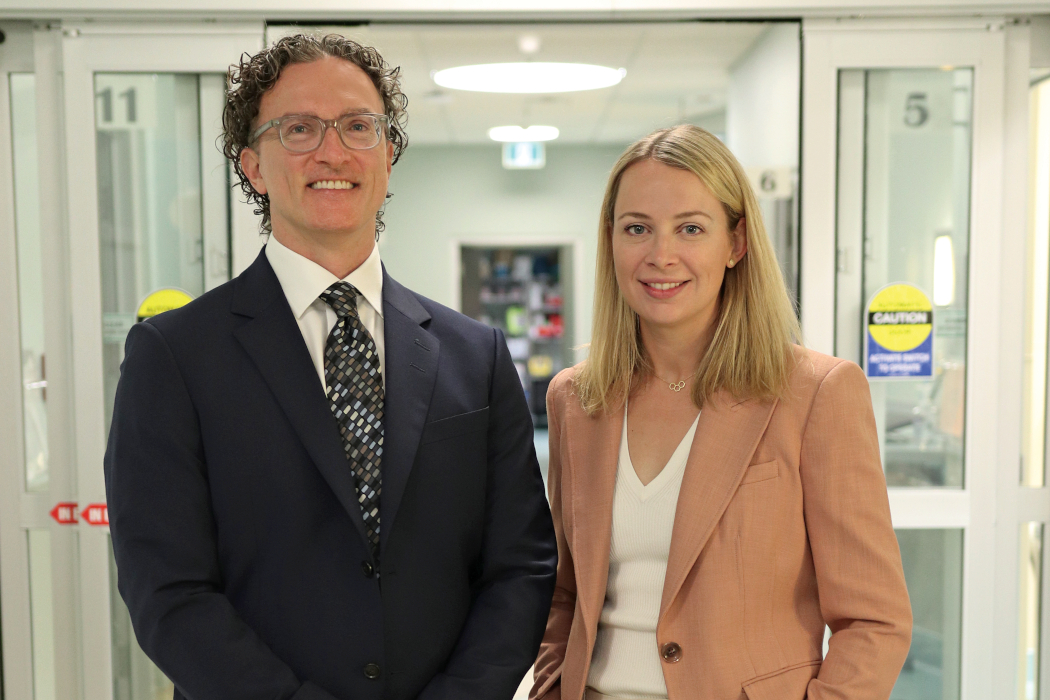
Rady Faculty researchers Dr. Ryan Zarychanski (left) and Brett Houston [B.Sc./09, B.Sc. (Med.)/13, MD/13, PhD/22] co-led a landmark trial that found an inexpensive drug reduced transfusions in major surgery.
Aurora is currently supporting several clinical trials including transplant rejection, chemotherapy administration and sexual dysfunction.
“For more than a century, medicine has separated caring for patients from learning how to care for patients better,” Zarychanski says. “Every patient interaction should be an opportunity to improve care.”
That vision is driving Zarychanski’s work. From training the next generation of clinical trialists, to building the infrastructure for embedded clinical trials, to positioning Manitoba as an international leader in this area.
“The future of medicine isn’t simply discovering new treatments,” he says. “It’s creating a health-care system that learns from every patient, every day.”
This article appeared in the Summer 2026 issue of RadyUM magazine. Published in print and online twice per year, Rady UM brings you the latest news from across the six colleges of the Rady Faculty of Health Sciences. Read more stories from the latest issue.
Boilerplate: Research
For nearly 150 years, UM has transformed lives through groundbreaking research and homegrown innovation. We push the boundaries of knowledge and do the hard work here in Manitoba to move our community and the world forward. With a spirit of determination and discovery, we are shaping a better future for our province and beyond.