
Estimated Read Time:
4 minutes
Estimated Read Time:
4 minutes
Just four years ago, Sebastien Regnier wasn't thinking about chasing the Olympic dream. The University of Manitoba graduate had a solid plan: he was headed for a Master’s degree in Physiotherapy after completing his B.Sc in Biology.
Fast forward today, the 26-year-old is one of Canada’s top up-and-coming skeleton athletes. Instead of working in a physio clinic, he spends his days training with some of the best winter athletes in the world as part of Canada's national team.
Regnier’s path changed thanks to Bisons sprint coach Rob Ellchuk. Ellchuk who has coached athletes who have gone on to become gold, silver and bronze Olympic and Paralympic medals in skeleton, encouraged Regnier to try the sliding discipline. So Reigner reached out to Canada's head coach, Joe Cecchini and in June 2023, he attended his first "push session" at the Ice House in Calgary, Canada's off-season training facility.
As a champion sprinter and captain of the Bisons track team, Regnier had the perfect mix of speed, power and focus. He learned to push the sled almost instantly.
"I remember [Joe Cecchini] telling me, 'I can get you to the Olympics,'" Regnier said. "I was like, how can you tell?"
Regnier had to make a difficult choice. He was set to start his physio degree in six weeks. At the time, he thought he could manage his academic workload and still train for skeleton beginning in the fall. But upon further reflection, he knew he'd have to make a choice.
After talking to friends, family, and coworkers, the answer was unanimous: go for it. So Reigner decided to bet on skeleton and moved across the country to Whistler, British Columbia, to train full-time. He moved into his new apartment just in time to attend his first training camp.
"[The coach] set me up to live in Whistler and work at the track. I moved into my apartment three days before that training camp."
Working at the track helped Regnier understand the sport from a different perspective, especially when he transitioned from the push phase, to full-on sliding.
The move turned out to be a great decision.
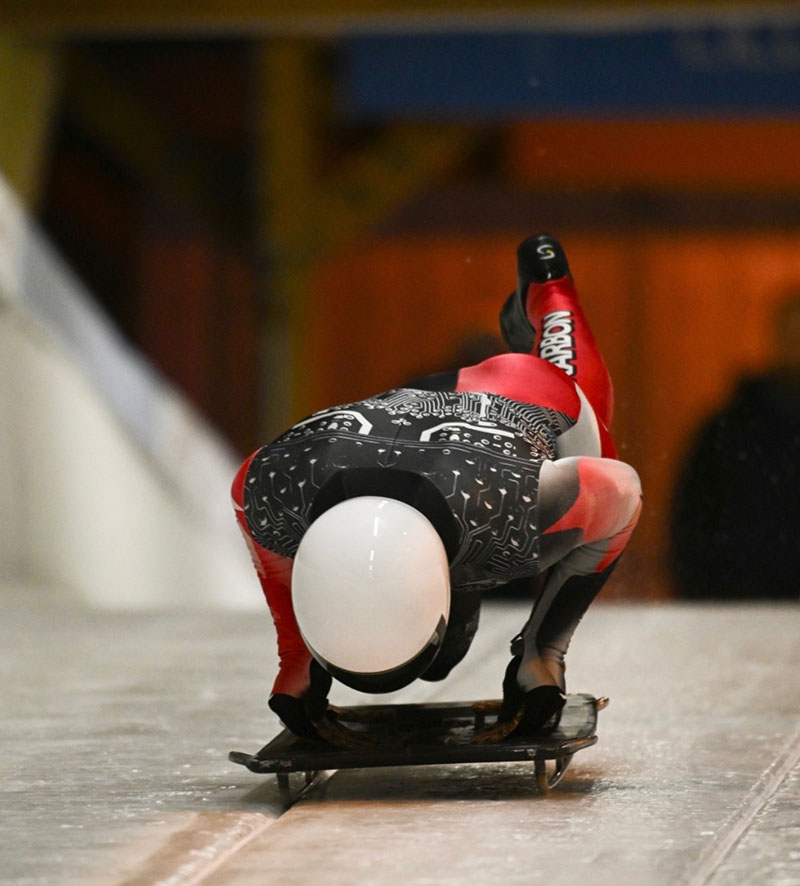
Photo by Viesturs Lacis.
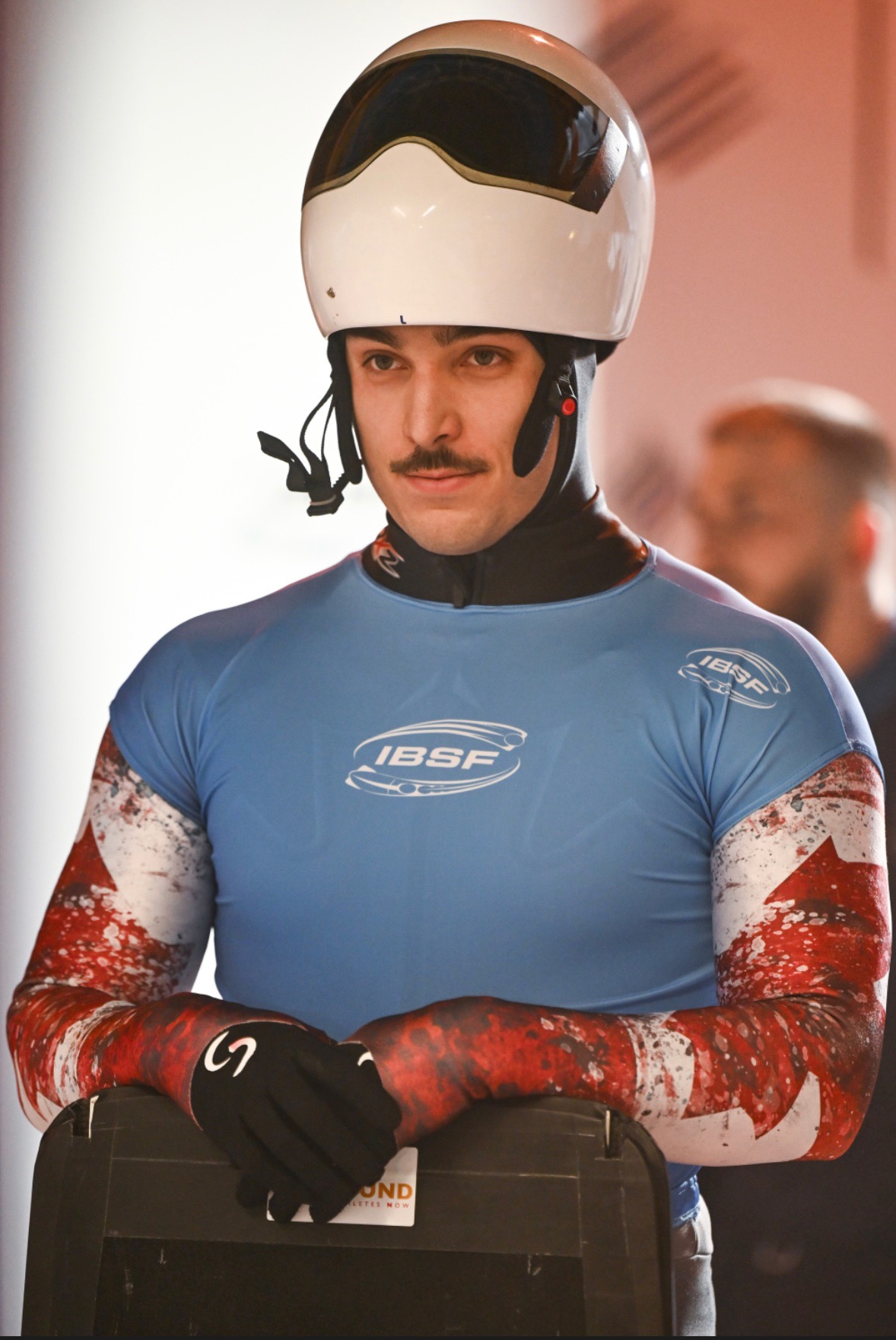
Photo by Viesturs Lacis.
After only eight practice sessions, Regnier broke the national record for the fastest start.
"After those first three weeks of crazy sliding, I was on the next gen team, which is part of the development program," said Regnier.
As the only recruit that year, the coach encouraged Regnier to start racing. Regnier lined up for his first event in Park City, Utah in December that year where he had a breakout performance.
"That track is very friendly, it's so different than in Whistler. In Park City, your start is super important because it's a glider track. If you have a really good start, and you do nothing you'll go fast there."
With two top ten performances in Park City, "The Bison" was showing what he was made of.
"I was super excited to get two top tens. I didn't really know what I was doing still."
Regnier says that location will always be a really special track for him because that's where he got my first races, and they went really well."
Early on in his training, he earned the nickname of "The Bison" because he proudly wore his University of Manitoba clothes to every practice to show where he came from.
The sport of skeleton is as dangerous as it is fast. Athletes lie face-down on a small sled and fly down an icy track. They reach speeds of 140 km/h and feel heavy pressure on their bodies—up to 5G of force—as they go through sharp turns. Olympic tracks can have up to 16 corners to navigate.
"I was crashing everywhere," Regnier recalled after moving from a training sled to a racing sled. "I had to almost re-learn everything I had learned on this new sled."
The transition was not always easy. He suffered a dislocated shoulder early in his career, and has taken many bumps and bruises, learning countless lessons along the way. Through it all, he leaned on the support of those he trusted, including his veteran teammates and Ellchuk, a fellow UM grad and Bisons track and field alum.
Through patience, perseverance and a tireless work ethic, Regnier continued to improve and landed on watch list for the 2026 Winter Olympics. The Olympic dream for 2026 was derailed due to a torn quad muscle during the qualifying period.
Despite the pain and the missed opportunity, he remained patient. He used a tireless work ethic to recover and get back on the ice.
He recently traveled to Norway to help his national teammates Hallie Clarke, Jane Channell and Josip Brusic prepare for their own Olympic races. Even though he won't be competing this year, being around the world's best has made him even more motivated.
"I'm so excited to watch the Olympics; for my teammates."
"Being able to train with, and being alongside, them was super motivating. This is where I want to be," said Reigner. "I know I'll get there, it's just a matter of time.
No matter where the sled takes him, Regnier's UM roots are with him wherever he goes.
"Before I made it on the national team ...This is what I did. If I hadn't been here running track, I wouldn't be here doing skeleton for Team Canada," he said.
"It's super special to be an alum from the UM and still have so many friends on the team. It really never feels like I'm disconnected from the Bisons. I'm still part of the Herd, and I always will be."
The University of Manitoba is proud to be the alma mater to Bisons who are at the centre of advancing national and international conversations, and action on issues that matter.
The Rady Faculty of Health Sciences held several events to help UM alumni connect with classmates and colleges.
Dr. Sara Goulet gave the Alan Klass Memorial Address at Max Rady College of Medicine’s Inaugural Day Exercises and White Coat Ceremony.
Meet the new occupational therapy department head, Dr. Cara Brown.


